
Platform
The enterprise AI platform that turns your legacy into AI-ready for agents and solutions
OpenLegacy Hub securely connects to your legacy systems and generates modernization-ready APIs, without rewrites. Start with your most complex system or go all the way to full modernization, one business process at a time.
Overview
Your core systems already hold what AI needs
The systems that run the enterprise hold decades of business data and logic, and they are the hardest to change. Big-bang rewrites stall while the core keeps running. OpenLegacy Hub takes a different path: discover what is there, connect it as governed APIs and agent tools, and modernize one business process at a time.
BEN.01
No big-bang risk
Legacy and modern run side by side while each process moves. Legacy stays live as the fallback.
BEN.02
Faster time-to-market
APIs, events and services are generated from existing assets instead of hand-built integrations.
BEN.03
AI-ready by design
Only the logic each service needs, exposed as governed tools that agents can discover and invoke.
Platform architecture
From systems of record to agents, on one governed platform
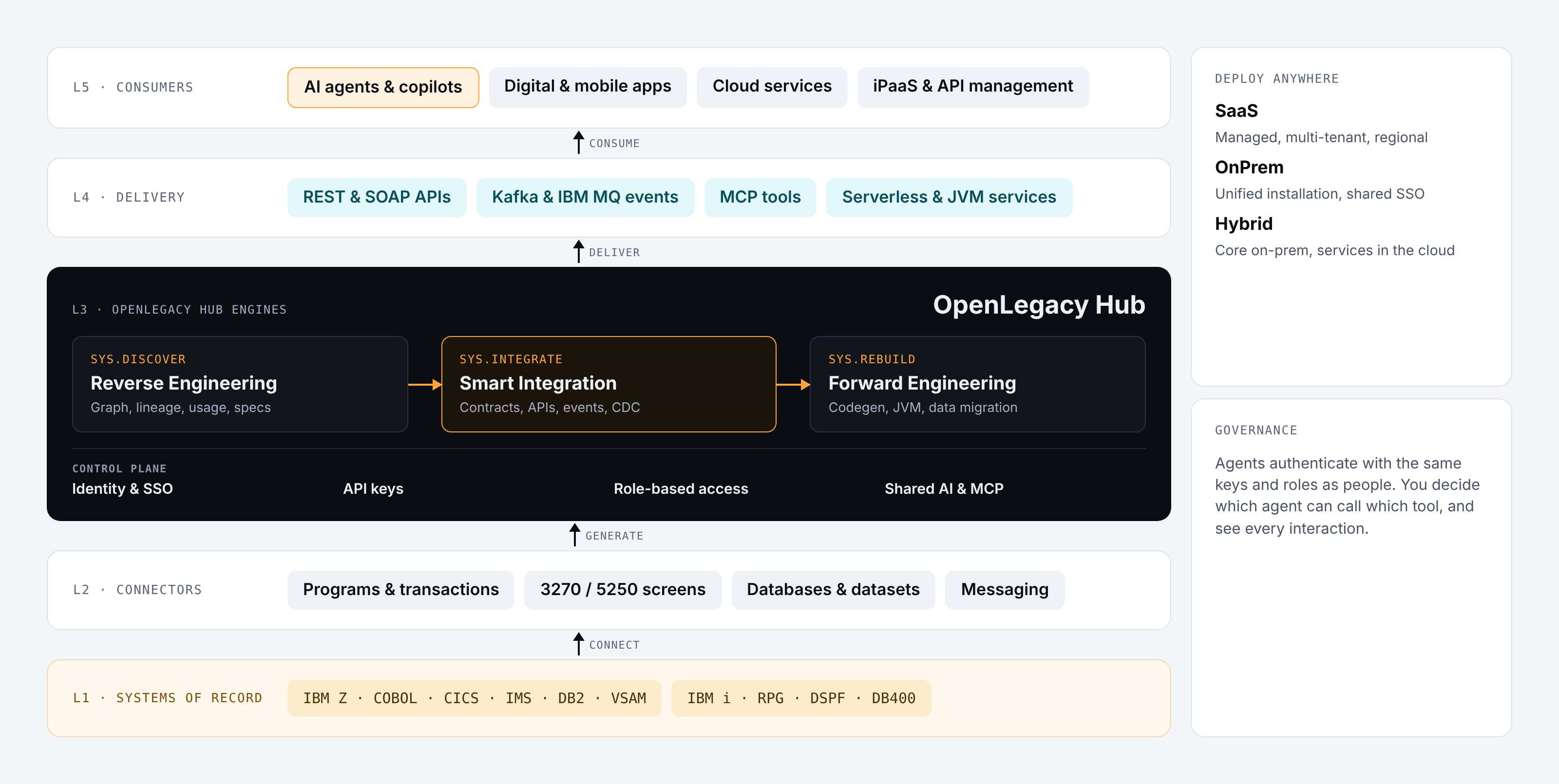
Systems of record on IBM Z and IBM i connect to OpenLegacy Hub without host changes. Three engines discover, integrate and rebuild on one inventory, one set of specs and one security model, then deliver governed APIs, events, MCP tools and services to AI agents, apps and cloud services. Agents use the same keys and roles as your people.
Technology-agnostic by design
OpenLegacy Hub fits within any cloud and stack. Stay on-prem, go hybrid, or migrate to the cloud at your own pace, and run the platform as managed SaaS or a unified OnPrem installation.
Works with AWS, Azure, Google Cloud, Kubernetes, Kafka, API management, iPaaS and CI/CD.
Platform features
Everything it takes to make legacy AI-ready
FEAT.01
Automated legacy discovery
Map programs, dependencies, field-level data lineage and real terminal usage across COBOL and RPG estates: evidence instead of tribal knowledge.
FEAT.02
AI-generated business specs
Turn discovered operations into reviewable business process specifications and API boundaries: the blueprint for every service you build next.
FEAT.03
Governed APIs and events
One contract produces REST, Kafka, IBM MQ, serverless and SOAP endpoints from programs, screens and data, tested and deployed without changing the host.
FEAT.04
Agent-ready MCP tools
Publish approved legacy operations as tools that MCP-compatible agents discover and invoke: live systems of record, no data copies, no screen scraping.
FEAT.05
Legacy–modern coexistence
System APIs in, Reverse APIs out, change data capture and gated routing keep legacy and new services in step while you decouple, with no cutover weekend.
FEAT.06
Forward engineering and replatforming
Generate new services from approved specs, validated against legacy behavior, or run screen and RPC programs on the JVM and move data on your schedule.
Security and governance
Built for regulated enterprises
Opening the core to apps and AI agents only works if every access is secure, governed and traceable. OpenLegacy Hub builds that in from the first connection.
TRUST.01
Secure by design
Enterprise single sign-on, tenant isolation and encrypted credentials, while your existing host security stays in force.
TRUST.02
Governed access
Roles and approvals decide who can see, change or call what, and AI agents follow the same rules as your people.
TRUST.03
Audit and traceability
Access decisions, changes and agent actions are recorded, and every service traces back to the legacy logic and data it came from.
Latest updates
What's new in the platform
Oct 2026 · Legacy to AI
Agents can now work across terminal discovery end to end
MCP tools now cover workspaces, screens, maps, recorded journeys, operations, reports and alerts, so AI agents can list, inspect and update them. Design changes stay protected whenever design time is locked.
Oct 2026 · AI agents
Human approval steps in agent workflows
A published agent workflow can pause for approval. The caller sees the title, message and preview, then approves or rejects, with an optional reason and edits merged in on approval.
Oct 2026 · Reverse engineering
Mock terminal sessions from recorded journeys
Play back a stored terminal journey instead of a live host, and record signed-in sessions as new journeys. The sign-on itself is never recorded.
Make your legacy AI-ready, without a rewrite
See OpenLegacy Hub connect to your own systems and deliver your first agent-ready service.
Start with one process
Tell us which system you want to make AI-ready first and we will get back to you.
Thanks — we received your message.
Something went wrong. Please try again.