
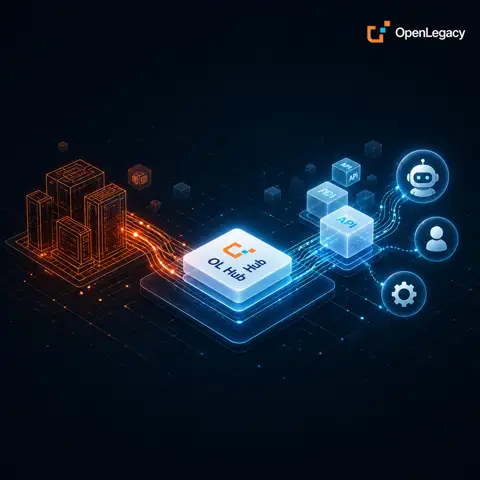
The platform that turns legacy into AI-ready
OpenLegacy Hub securely connects to your legacy systems and generates modernization-ready APIs, without rewrites. Here is how it takes core systems from discovery to AI-ready, one business process at a time.
The systems that run the enterprise hold decades of business data and logic. They are also the hardest systems to change. Big-bang rewrites stall, and the core keeps running anyway.
OpenLegacy Hub takes a different path. It securely connects to your legacy systems and generates modernization-ready APIs, without rewrites. Start with your most complex system or go all the way to full modernization: one business process at a time.
Purpose-built for safe modernization
- No big-bang risk: legacy and modern run side by side while each process moves.
- Faster time-to-market: generated APIs and services instead of hand-built integrations.
- Lower cost: no heavy middleware layers to buy, build and run.
- Less context: only the logic each service needs, lean enough for AI.
A proven path to modernization
Three stages, one shared context. Everything on the platform works from the same inventory, specs and security, so nothing is discovered twice.
Reverse Engineering
Replace tribal knowledge with evidence. Map programs, dependencies, data lineage and real terminal usage, then turn what you find into reviewable business specs.
- Application graph, operations and domains from COBOL and RPG
- Field-level lineage across DB2, IMS and VSAM
- AI-authored business process specs and API boundaries
Smart Integration
Turn programs, screens, transactions and data into governed APIs and events: contract-first, tested, and deployed without changing the host.
- REST, Kafka, IBM MQ, serverless and SOAP from one contract
- RPC and 3270/5250 screen flow methods
- DB2, VSAM and IMS data APIs plus VSAM change data capture
Forward Engineering
Reimagine one business process as a new service, validated against legacy behavior, or move screen and RPC programs off the host to the JVM while teams keep editing the original COBOL and RPG.
- Code generation from approved specs, including UI, data model and OpenAPI
- CICS, IMS and IBM i programs replatformed to the JVM
- Data moves on your schedule: VSAM CDC first, then VSAM-to-SQL migration
One control plane
Underneath the three stages, OpenLegacy Hub provides one foundation for every team and every agent:
- Shared identity: SSO, tenancy and master licensing
- API keys: for the CLI, agents, MCP and generated services
- Access control: roles across projects, connections and resources
- AI and MCP: agents use the same keys and roles as people
Run it as SaaS or OnPrem. Stay on-prem, go hybrid, or migrate at your own pace.
Modernize without compromise
De-risk. OpenLegacy Hub progressively decouples legacy systems and integrates them into modern architectures. Legacy stays live as the fallback.
Accelerate. APIs, events and services are generated from existing assets instead of being hand-built, so new digital services reach the business sooner.
Future-proof. OpenLegacy Hub is technology-agnostic and fits within any cloud and stack. Stay on-prem, go hybrid, or migrate to the cloud at your own pace.
Start where your business needs it most
- API Integration: turn mainframe and IBM i programs, screens, transactions and data into governed APIs and events without rewriting the core.
- Legacy to AI: turn hidden mainframe and IBM i programs and data into governed tools for AI agents.
- Legacy–Modern Coexistence: run legacy and modern side by side with System APIs, Reverse APIs, change events and gated decoupling routes.
- Agentic Mainframe Development: a context-aware browser workspace to understand, change, document and API-enable COBOL, CICS, IMS, DB2 and VSAM.
- Code Replatforming: run CICS, IMS and IBM i screen and RPC programs on the JVM while teams keep editing the original COBOL and RPG.
- AS/400 (IBM i) Modernization: browser 5250 access, RPG and DSPF analysis, governed APIs, and RPGLE that runs off the host.
Give AI agents the systems that already run your business
No disconnected data copies, no agents scraping green screens. Agents get controlled access to live systems of record, retrieving approved data and calling real business programs, while you keep control of credentials, permissions and oversight.
- Discover legacy assets: find the programs, transactions, datasets and tables that hold high-value business knowledge.
- Create an API-ready business surface: documented APIs with defined inputs, outputs and publishing controls.
- Expose agent-ready tools: approved APIs become tools that MCP-compatible agents can discover and invoke.
- Govern access and execution: control which agents use which tools, manage credentials, keep visibility.
- Expand from insight to action: start with retrieval, then let agents call approved business processes.
Global enterprises modernize critical systems faster, with no disruption
- Citi accelerated host-to-host implementation for global financial operations, connecting legacy host systems to modern cloud-based treasury and payment services without disruptive core changes.
- Globe Life launched Customer Portal 2.0 with real-time mainframe connectivity from 3270 screens, on schedule, without refactoring its mainframe cores.
- Grupo Herdez exposed IBM i RPG, CL and DB2 functions as cloud-native services and deployed them to Google Cloud Application Integration.
Works with your cloud and modernization ecosystem
OpenLegacy Hub speaks IBM Z (COBOL, CICS, IMS, DB2, VSAM) and IBM i (RPG, DB400) natively, and plugs into AWS, Azure, Google Cloud, API management, iPaaS, CI/CD, DevSecOps, Kafka, Snowflake and Kubernetes.
It is built for industries where downtime is not an option: financial services, insurance, manufacturing and retail.
Ready to see it in your environment?
Start with one process. Start today.