
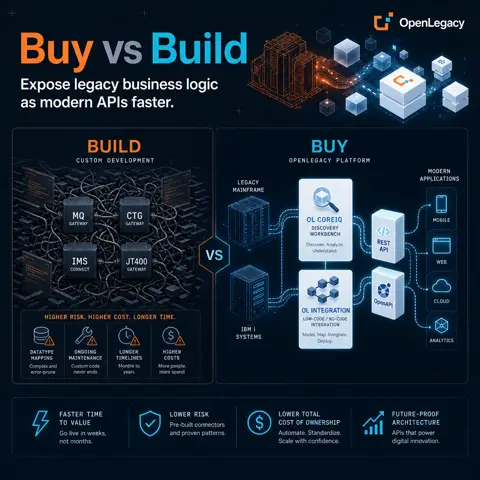
Buy vs. Build
Buying a proven API integration solution helps teams expose mainframe and IBM i business logic faster, with less custom code, less datatype risk, and more repea…
Buy vs. Build: Choosing the Right API Integration Path for Legacy Modernization
Buying a proven API integration solution helps teams expose mainframe and IBM i business logic faster, with less custom code, less datatype risk, and more repeatable scale than building around gateways like MQ, CTG, IMS Connect, or JT400.
Buy vs. Build for Legacy API Integration: What Are You Really Choosing?
When organizations evaluate legacy modernization, the decision is rarely just “buy software” or “write code.” It is a choice between two operating models.
A build approach often starts with low-level connectivity through technologies such as MQ, CTG, IMS Connect, or JT400. These gateways can provide access, but the enterprise team is still responsible for interpreting legacy assets, handling complex data structures, creating API contracts, documenting behavior, testing flows, and scaling delivery across many services.
A buy approach with OpenLegacy focuses on turning existing legacy business logic into modern APIs without rewriting the core systems. OL Integration is designed to expose mainframe and IBM i business logic as modern APIs, while OL CoreIQ helps teams discover, test, and document mainframe assets from a unified browser workbench.
Why Building on MQ, CTG, IMS Connect, or JT400 Can Slow Modernization
Gateways and low-level connectors can be useful building blocks, but they do not remove the main modernization workload. Internal teams still need to create and maintain the integration layer around them.
Custom Code Increases Delivery and Maintenance Effort
A self-developed solution usually requires custom adapters, hand-built mappings, documentation, testing tools, and operational conventions. That work can multiply across programs, transactions, datasets, and downstream consumers.
By contrast, Legacy Connectors provide ready connectivity to Mainframe, IBM i, SAP, Oracle, DB2, messaging, and more, reducing the need to start every integration with custom adapter development.
Legacy Datatypes Add Risk
Mainframe and IBM i integrations often involve complex datatype handling, copybook interpretation, dataset structures, and transaction-specific behavior. When these concerns are handled manually, teams can spend significant effort validating fields, layouts, and runtime behavior before an API is safe to expose.
VSAM dataset browse, layout, and API helps teams browse and inspect VSAM and other mainframe datasets in the browser, associate COBOL copybooks into a Datasets catalog, and expose published dataset content through CoreIQ REST APIs.
Limited Automation Makes Scale Hard
A build-it-yourself approach may work for a small number of integrations, but modernization programs usually need repeatability. Without a shared workbench, reusable contracts, cataloged assets, and consistent API patterns, each new service can become a separate engineering project.
Why Buy OpenLegacy for No-Code, Reliable API Delivery
OpenLegacy’s value is not simply connectivity. It provides a practical modernization path that combines discovery, integration, API definition, and documentation into a more repeatable delivery model.
Discover and Understand Before You Expose
OL CoreIQ gives teams a browser-based workbench to discover, test, and document mainframe assets. This matters because modernization teams need to understand the legacy asset before exposing it to digital channels, applications, partners, or internal services.
Expose Business Logic Without Rewriting Core Systems
OL Integration helps expose mainframe and IBM i business logic as modern APIs without rewriting core systems. This supports a pragmatic modernization strategy: preserve proven systems of record while making their capabilities easier to consume through APIs.
Start from Contracts, Not Ad Hoc Endpoints
With Contract-First & Friendly APIs, teams can define Hub contracts as the API source of truth, then enrich them with AI-generated readable names, descriptions, and specs agents can use. This supports clearer API governance and improves usability for downstream consumers.
API Modernization at Scale: Where OpenLegacy Fits
For organizations with many legacy assets, the main challenge is not creating one integration. It is creating a sustainable factory for API delivery.
OpenLegacy supports this by combining:
-
Asset discovery and documentation through OL CoreIQ
-
Legacy business logic exposure through OL Integration
-
Ready connectivity through Legacy Connectors
-
Dataset inspection and API access through VSAM dataset browse, layout, and API
-
Contract-first API definition through Contract-First & Friendly APIs
This helps reduce reliance on one-off development patterns and improves consistency across modernization initiatives.
When to Buy Instead of Build
Buying is the better fit when the goal is to modernize legacy access reliably and repeatedly, not merely connect to a legacy endpoint.
Consider OpenLegacy when your team needs to:
-
Expose mainframe or IBM i logic as APIs without rewriting the underlying systems
-
Reduce custom adapter development
-
Improve handling of legacy structures and datasets
-
Create clearer, contract-first APIs for consumers
-
Scale integration delivery beyond a few manually built services
-
Use a solution backed by a decade of legacy integration experience
Building may still be reasonable for narrow, isolated cases. But for enterprise modernization, the cost of custom code, datatype complexity, limited automation, and ongoing maintenance often makes a proven integration platform the more practical path.