
Modernize Banking and Financial Services Without Disruption
Open Banking, real-time payments, and AI-driven fraud detection all need the same thing: fast, governed access to what's already running on the mainframe or IBM i, not a rip-and-replace program.
Core banking systems hold the logic that runs the bank. Modernizing them isn't about ripping them out. It's moving safely, in phases, without risking the business. That's what OL Hub is built for.
What's holding financial services back
- Open Banking and regulatory deadlines (PSD2, GDPR, CCPA) outpacing what a rewrite program can deliver
- Mobile and digital banking expectations a green-screen core can't meet directly
- Payment rails going real-time while the ledger still runs in batch
- Fraud and AI models needing live access to data locked in VSAM and DB2
- Mainframe MIPS and middleware costs that grow every year modernization waits
Where OpenLegacy delivers value
Core banking modernization. Expose COBOL and CICS logic as governed APIs and decouple one domain at a time. See Legacy–Modern Coexistence.
Open Banking API factory. Generate contract-first APIs straight from COBOL copybooks and CICS transactions, with no bespoke integration project per API. See API Integration.
Real-time payments. Expose CICS and MQ entry points as Kafka and IBM MQ events from the same contract used for REST. The ledger stays put; the interface goes real-time.
Digital lending. Expose eligibility, scoring, and approvals as APIs without touching core code, so origination moves at its own pace.
Fraud and AI enablement. Reach VSAM and DB2 transaction data in real time via Legacy Data APIs, then put agents on top of it with OL Gene. No separate integration project.
How it works with your core systems
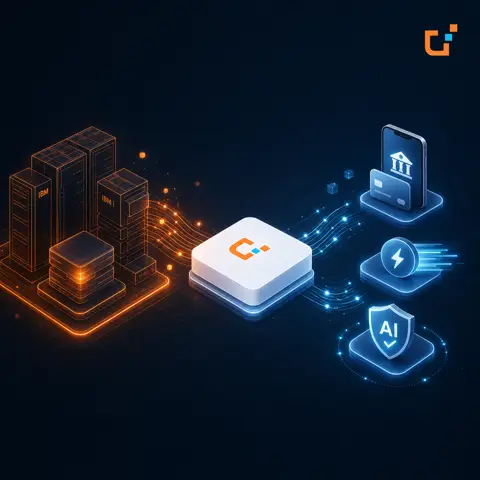
Nothing here replaces the core. OL Hub connects directly to mainframe, IBM i, COBOL/CICS, VSAM, IMS, and DB2, and generates cloud-ready APIs while legacy and modern run side by side.
- External decoupling: expose mainframe logic as APIs for digital channels and partners; the mainframe stays the system of record.
- Internal decoupling: modernize one business function at a time, independent of a system-wide cutover.
- Data layer decoupling: unlock DB2, VSAM, and IMS data for AI and streaming with far less middleware.
The OL Hub lifecycle behind every phase
- Discover: OL AtomIQ and OL TermIQ map the estate from real usage, not guesswork.
- Blueprint: OL Spec turns that inventory into a reviewable spec and API plan.
- Build and run: OL Integration, OL CoreIQ, OL DataIQ, and OL Code generate, test, and deploy, governed by OL Hub end to end.
Proven results, real banks
Bank Leumi: COBOL copybook to microservice in 5 minutes; 8 microservices in one week with one developer; 100% Open Banking compliance.
Banorte: replaced an ESB bottleneck with direct mainframe connectivity: 20x faster API lifecycle, 30% more throughput.
Citi: the same direct-connectivity approach, applied to global treasury and payment host-to-host connectivity.
Why build it on OL Hub
- Ship the first API in days, not months. Discovery's already done by OL AtomIQ and OL TermIQ.
- One platform, not a stitched-together stack. Discovery, blueprinting, APIs, events, and data access all move on the same roadmap.
- AI-ready from day one. The same governed APIs fraud models reach today are what AI agents reach through OL Gene tomorrow, with no second project to bolt on AI.