
OL-Terminal: Accelerate Legacy Modernization – Eliminate Desktop Terminals
Streamline mainframe access and modernization with OL-Terminal, a browser-based terminal emulator that eliminates desktop infrastructure, accelerates API development, and supports remote work globally.
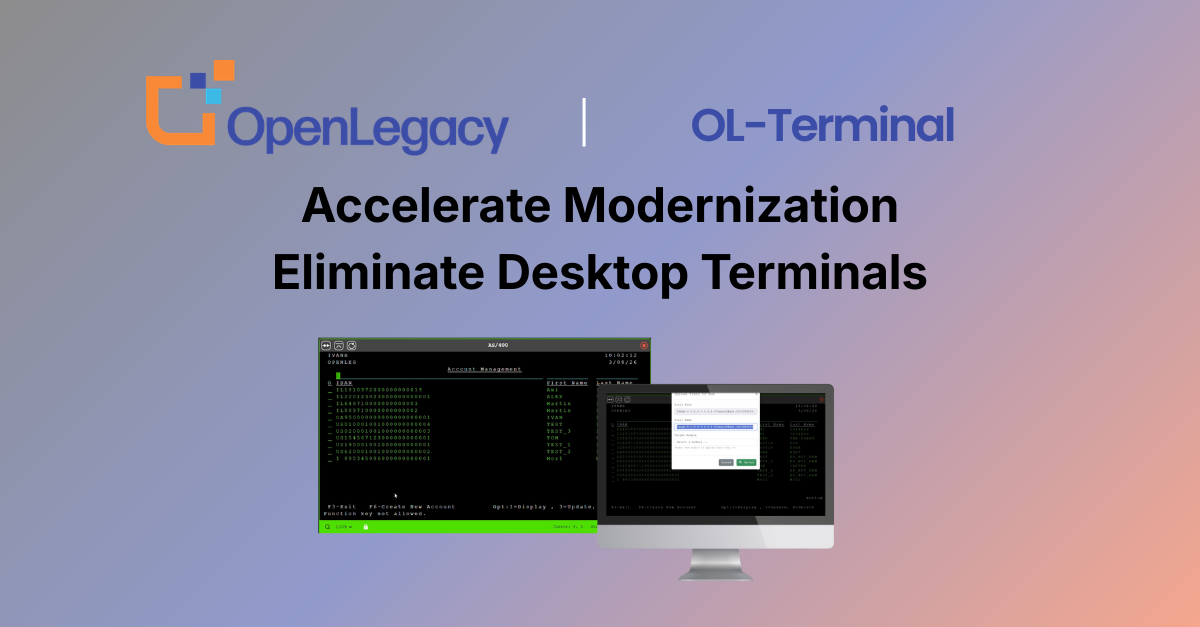
OL-Terminal is a browser-based terminal emulator from OpenLegacy that eliminates desktop client infrastructure, enables remote access for mainframe teams worldwide, and turns recorded terminal sessions into production REST APIs, without touching a line of COBOL
The Business Case: Why OL-Terminal Matters Now
Legacy terminal access has always been a hidden cost center. The real expense isn't the mainframe, it's everything that surrounds it: thick clients, dedicated hardware, version-specific emulator licenses, VPN configurations, and costly IT support.
1. Eliminate TCP & Desktop Terminal Infrastructure
Traditional terminal emulators require individual installation, licensing, and configuration on every workstation. IT teams spend significant cycles managing version updates, TN3270/5250 TCP connections, firewall rules, and troubleshooting connection failures. With OL-Terminal, that entire layer disappears. There is nothing to install, no TCP client to configure, and no emulator software to maintain.
2. Accelerate Modernization Velocity
OL-Terminal is not just a pretty terminal window, it is a modernization accelerator embedded in the workflow. Developers can record multi-screen mainframe navigation sequences directly inside the terminal and save them as screen modules to OpenLegacy Hub. These recordings become the building blocks for automated, screen-flow-based REST APIs, turning hours of manual developer effort into minutes.
3. Enable True Remote Work for Mainframe Teams
For decades, mainframe access meant being on-premise or enduring the complexity of VPN tunneling into a terminal emulator. OL-Terminal breaks that constraint entirely. Because it runs in the browser, your mainframe operations teams, developers, and business analysts can securely access any configured system from anywhere; a home office, a client site, a laptop in an airport lounge.
This is not just a quality-of-life improvement; it is a workforce resilience capability. Enterprises can now hire mainframe talent globally, support distributed operations teams, and eliminate the geographic constraints that have historically limited mainframe skill acquisition. In an era where hybrid and remote work is the default, forcing your most business-critical systems to require on-site access is an operational risk OL-Terminal resolves without touching your mainframe configuration.
"The terminal isn't a bottleneck — the infrastructure around it is. OL-Terminal removes that friction while keeping the mainframe exactly where it belongs: at the heart of your operations."
4. Reduce Support Costs at Scale
Centralized browser-based access means IT controls the terminal environment from one place. Updates to connection profiles, keyboard mappings, and session parameters are managed centrally and users simply refresh their browser. Organizations with hundreds or thousands of terminal users see measurable reductions in per-seat support overhead.
Key Capabilities: What You Get with OL-Terminal
⚡ Instant Session Start
Select from available connections or auto-connect to a favorite. No per-user configuration — zero onboarding friction.
🌓 Dark & Light Mode
Ergonomic display modes with adjustable zoom for extended sessions. Reduce eye strain across different working environments.
⌨️ Full Keyboard Fidelity
Arrow keys, Tab, and all function keys work exactly as expected. Flexible keyboard mapping lets teams assign custom actions.
🔁 Macro Automation
Record sequences of keystrokes to automate repetitive workflows. Save hours of manual navigation daily across your operations team.
🖨️ AS/400 Printer Spool
Dedicated printer panel to browse, filter, preview as PDF, download, or print spool files directly from the browser.
🔗 API Recording to OL Hub
Record screen scenarios and save them directly to an OpenLegacy Hub screen module. The fastest path from terminal workflow to REST API.
◈ ANALYTICS ENGINE — TERMIQ BY OPENLEGACY
Meet TermIQ: AI-Powered Process Intelligence
Recording terminal sessions is powerful — but understanding them at scale is where TermIQ comes in. TermIQ is OpenLegacy's process analytics engine built to sit alongside OL-Terminal and apply AI-driven analysis to what's actually happening on those green screens.
Most enterprises have hundreds or thousands of terminal workflows that have evolved organically over decades. Nobody has a complete map of them. Business analysts know what the screens do; developers know which transactions they call — but the full picture is tribal knowledge locked inside a shrinking workforce.
What TermIQ Does
-
Identifies business processes from screen sequences — TermIQ recognizes patterns across multi-screen flows (CICS transactions, AS/400 menus, IMS forms) and clusters them into business scenarios like 'new account opening,' 'policy renewal,' or 'inventory adjustment.' No manual mapping required.
-
Understands business context from screen data — Field labels, data patterns, transaction codes, and navigation logic are analyzed to infer what a scenario is actually doing. TermIQ distinguishes a 'quote creation' flow from a 'policy issuance' flow even if they share similar screens.
-
Surfaces modernization priorities — By quantifying which workflows are used most frequently and carry the most risk, TermIQ gives modernization teams a data-driven prioritization engine.
-
Accelerates API discovery — Insights from TermIQ feed directly into OL-Terminal's recording workflow and OpenLegacy Hub, compressing the path from 'identified process' to 'working API' from weeks to days.
TermIQ turns your terminal usage history into a living blueprint of your business — making it the essential first step in any mainframe modernization program.
From Terminal to API: The Complete Modernization Pipeline
OL-Terminal and TermIQ together represent a complete, end-to-end modernization entry point that requires no changes to your mainframe environment:
01
Access
Deploy OL-Terminal as a browser-based terminal gateway. Teams connect to CICS, z/OS, or AS/400 immediately. No desktop clients, no TCP configuration, no new mainframe software.
02
Analyze
TermIQ analyzes terminal usage patterns, identifies business processes from screen sequences, and produces a prioritized modernization roadmap. Discovery that took months now takes days.
03
Record
Developers use OL-Terminal's built-in recording to capture screen flows for high-priority processes identified by TermIQ. Recordings are saved directly to OpenLegacy Hub.
04
Expose
OpenLegacy Hub transforms recorded screen flows into clean, documented REST APIs — automatically. The mainframe logic stays untouched; the world gets a modern API interface.
05
Scale
With each API created, your digital surface expands. New web apps, mobile interfaces, and integrations can consume mainframe data through standard REST — without changing a line of COBOL.
Ready to See OL-Terminal in Action?
Watch the full product demo or connect with our team to schedule a tailored walkthrough.