
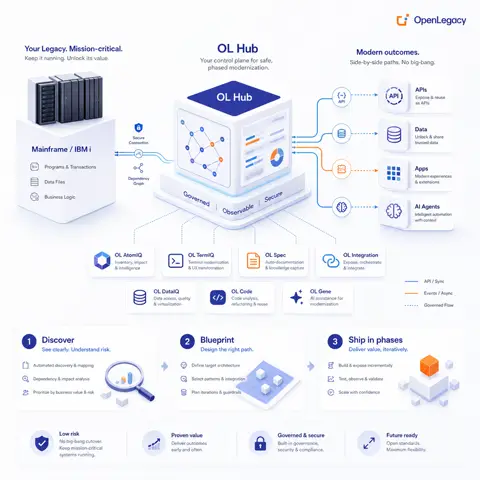
The OL Hub Platform: Modernize Without Risk, At Your Pace
Legacy modernization fails when it's one big rewrite or a single black-box tool. OL Hub is neither. It's the control plane for a real product suite that discovers, blueprints, and ships modernization work in phases.
Modernization programs fail three ways: nobody mapped the dependencies, middleware and rewrites cost more than they save, or a big-bang cutover risks the business on one weekend. OL Hub avoids all three: discover what's real, blueprint the safe path, and ship it in phases.
Why modernization fails
- Hidden dependencies break things. OL Hub starts from real usage and real code, not assumptions.
- Middleware and rewrites add cost. OL Hub generates governed APIs directly from what's already running, with no parallel platform to maintain.
- Big-bang cutovers risk downtime. Legacy and modern run side by side until you're ready to shift.
The platform, not a black box
OL Hub isn't one "integration engine" and one "planning tool." It's a control plane governing a real product suite:
- OL Integration (GA): mainframe and IBM i logic as modern APIs and events.
- OL TermIQ (RC): business processes and screen flows discovered from real terminal usage.
- OL Code: COBOL and RPG development and API-enablement in a web IDE.
- OL Spec (beta): AI-generated specs and modernization blueprints.
- OL DataIQ: data across legacy and modern databases, queried and migrated.
Behind those: OL CoreIQ (mainframe workbench), OL Terminal (browser 3270/5250), OL AtomIQ (decomposition planning), OL AppIQ (modern apps on OL assets), OL Z Gateway (IBM Z dataset APIs), and OL Gene (AI agents on top of all of it). Maturity varies by product (GA, RC, beta), stated plainly, not smoothed over.
How it works
- Discover: OL AtomIQ and OL TermIQ map dependencies and real usage before anything is touched.
- Blueprint: OL Spec turns that inventory into a reviewable spec and phased plan.
- Build and run: OL Integration, OL CoreIQ, OL DataIQ, and OL Code generate, test, and deploy, governed end to end by OL Hub.
Modernization patterns, built in
- External decoupling: modern APIs for digital channels and partners; the mainframe stays system of record.
- Internal decoupling: modernize one business function at a time, no system-wide cutover.
- Data layer decoupling: unlock legacy data for AI and streaming with far less middleware.
Why build it on OL Hub
- Ship the first API in days, not months. Discovery and blueprinting already happened on the same platform.
- One platform, not a stitched-together stack. Discovery, APIs, data access, and AI agent access all move on one roadmap.
- AI-ready from day one. The same governed APIs every product exposes are what OL Gene and outside agents reach, with no second project.