
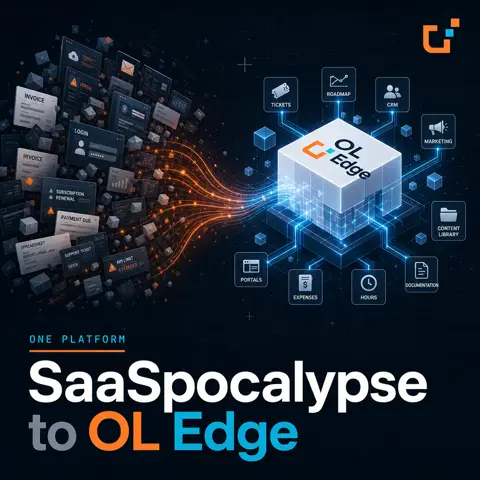
The SaaSpocalypse is real. We just lived it.
How OpenLegacy replaced its entire internal SaaS stack in two months with OL Edge: one AI native platform with portals, MCP access, chat agents, media and decks, in four languages.
The SaaSpocalypse is real. We know, because we just lived through it.
Two months ago OpenLegacy ran on the same stack as every growing software company.
Jira for tickets. Aha for product management. HubSpot for the website, leads and campaigns. Salesforce for clients and deals. PathFactory for content. ReadMe for product documentation. Time Watch for client and internal hours. Expensify for expenses. LearnUpon for training. Three more systems for the partner portal, the client portal and the download portal.
A dozen logins. A dozen invoices. A dozen versions of the truth.
Today all of it runs on one platform we built ourselves: OL Edge. This is the story of what we replaced, what we gained, and why we think every software company should take a hard look at its own stack.
The stack we retired
Jira became Edge tickets
Engineering tickets live next to the catalog they change. Anyone can file a light request from the header, reply by email, search by ticket key, and run ticket reports whose charts open the filtered list. A note can become a ticket, or several tickets with parents and children, in one step from My Notes.
Aha became the catalog and the roadmap
Product management happens where the product is described. The product and feature catalog carries every product, feature, owner, maturity level and pending draft. The roadmap grid plans four quarters with cards that link to real products and features, and exports to PowerPoint. Around it sit the landscape matrix, product relations, domain journeys and competitor comparisons.
HubSpot became our website, campaigns and leads
Our public website is served from Edge through marketing surfaces, with a site chrome editor for the header, footer and theme, no release needed. Marketing builds campaign pages with AI and templates, captures visitors through a content gate, welcomes known users them with Google sign in, and reaches audiences with bulk email. Visitors book time with sales through meeting booking.
Salesforce became Edge CRM
People, accounts, deal flow with forecast and contact roles, lead conversion, field history and configurable form layouts. Gmail threads become CRM interactions. Licensing and projects show what each client runs. A relationship graph connects companies, people, meetings and products so search and agents can follow the same links we do. Our history came along through CRM archive import.
PathFactory became the content library and resource hubs
Official documents live in the company content library with role access per item. Datasheets, eBooks, videos and demos are published on resource hubs. Case studies, the FAQ and this blog sit next to the products they describe. Safe Send shares a file as a time limited link instead of an attachment.
ReadMe became product documentation in Edge
Product help is a versioned tree of pages on the product itself, published once for the help viewer, search and agents.
Time Watch and Expensify became Edge HR
Employee hours cover client and internal work: clock time, submit the month, managers approve. Expense reports are filed from the browser or straight from an agent. The org chart and training live in the same place.
Three portals became one
The client and partner portal uses magic link sign in bound to a CRM company, with downloads, documentation and a public safe advisor built in.
Making content, not just storing it
A platform that only stores content is still half a platform. Edge also produces it.
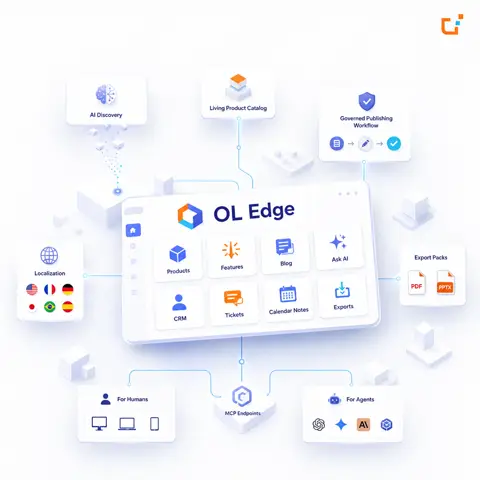
- One media library. Screenshots, documents and videos are uploaded once and reused everywhere: features, resources, decks, campaign pages and the public site. Employees can browse it, editors manage it under governance, and agents can upload and attach media through MCP.
- Deck and PDF generator. PDF and PPTX generate assembles live catalog items into a reading pack or a presentation. Decks can be just for us, internal, or public with their own link, and land on My content to share.
- Consistent image generator. AI images start from a brand template and the catalog context of the product or feature they illustrate, so every visual keeps the same style, palette and brand cues. No more stock art that looks like five different companies.
One platform, many doors
Every capability above comes with the same foundation:
- A public site view for the outside world through marketing surfaces
- Portals for employees, clients and partners
- Full MCP access through persona MCP endpoints, so any agent works with the same data our people do, plus machine API keys for automation
- Web and mobile access, including an installable app on the phone
- Chat agents inside the site: Ask AI and advisors for internal teams and for external visitors, with chat review for admins
- Role management on every object through admin governance
- Google Workspace: sign in, Gmail, Calendar and Drive built in
- Notifications by email, Slack and in app through the notification inbox, plus a company feed
- Localization in English, Spanish, Japanese and Hebrew, right to left included, with AI translated content that stays in sync
Edge runs Edge
The part we are proudest of: OL Edge is described and managed inside OL Edge. Its features, roadmap, tickets, documentation and What's New all live in the same catalog you are reading now.
And nobody writes them by hand. Our coding agents read the code as it changes, use Edge agent skills, and publish through MCP: new features, release notes, tickets from staged commits, help pages, media and decks. The product documents itself as it ships, in four languages, and the same skills are available to every OpenLegacy product team.
What we learned
The moat moved. The moat of most SaaS products was never the features. It was the cost of building them. That cost just collapsed. Building exactly what we need is now faster than configuring what someone else thinks we need.
Coherence beats savings. The license savings are real, but they are not the point. When the ticket, the feature, the roadmap card, the docs page, the blog post, the deal and the customer conversation all live in one model, nothing gets lost in translation. What R&D ships in the morning shows up in What's New, in the docs, on the website and in the sales agent's answers the same day, in every language we support.
Agents changed the equation three times. They write our code. They turn that code into product content. And they operate our systems. A SaaS tool an agent cannot fully operate is now a liability. Every capability in Edge is an MCP tool scoped by role, so any of us can ask an agent to log hours, update a deal or draft a release note, and it simply happens.
Speed comes from one model. We did not move faster because we cut corners. We moved faster because every new module plugged into the same catalog, the same roles, the same search, the same agents and the same languages. Each piece made the next one cheaper.
Why this matters beyond us
This is not about ripping out vendors for sport. It is a signal. If a company can rebuild its own operating system in two months, every per seat subscription deserves a hard look.
Modernization is what OpenLegacy does for its customers. This time we did it to ourselves.
The question is no longer build or buy.
It is: why are we still renting this?