What's Holding Manufacturing Innovation Back
The ambition to digitize operations, achieve end-to-end supply chain visibility, and connect shop floor equipment to cloud
analytics is clear across every manufacturing organization. The barrier is almost always the same: ERP systems, IBM i
environments, and legacy MES platforms that hold the operational truth — but were never designed to share it at the speed
modern systems require.

Real-time supply chain and logistics visibility
Expose inventory, order status, and logistics data from legacy ERP and IBM i systems as real-time APIs — feeding supply chain visibility platforms, demand planning tools, and logistics systems without batch delays or fragile middleware connections.

Shop floor and IoT integration
IoT sensors, digital twins, and production analytics platforms need operational context from legacy MES and ERP systems to calculate true OEE and reflect real production status. OpenLegacy bridges this gap — connecting legacy MES and ERP data to cloud IoT platforms without modifying the operational system.
-May-27-2026-06-13-47-7772-AM.svg)
B2B customer portal and order management digitization
Distributors and B2B customers increasingly expect self-service order tracking, pricing, and inventory availability. OpenLegacy exposes order management and pricing functions from legacy ERP systems as APIs, enabling modern B2B portals without a core ERP replacement or custom middleware build.
-1.svg)
Legacy ERP migration and augmentation
Full ERP replacement programs are high-risk, slow, and expensive. OpenLegacy enables a phased augmentation approach — exposing critical ERP functions as APIs, shifting workloads progressively to cloud-native services, and running legacy and modern environments in parallel until a safe cutover point is reached.
.svg)
Predictive maintenance and data lake hydration
Machine learning models for predictive maintenance need historical production data that lives in legacy ERP and MES systems — often in formats that modern data platforms cannot consume directly. OpenLegacy generates APIs and data feeds from these legacy sources, hydrating cloud data lakes and analytics platforms without schema changes or batch export dependencies.
.svg)
Reduce legacy integration complexity and cost
Manufacturing environments often rely on fragile point-to-point integrations and ESB layers connecting ERP, MES, WMS, and partner systems. OpenLegacy replaces these with direct, standards-based APIs — reducing integration maintenance cost, improving reliability, and creating a foundation for future system changes without cascading dependencies.
Connect Operations. Accelerate Digitization. Reduce Risk.

Faster Integration Delivery
Connect legacy ERP, MES, and IBM i systems to modern IoT, supply chain, and B2B platforms — in days, not months — without changing the operational systems underneath.

Cost Reduction
Reduce integration development and maintenance overhead through automation and direct connectivity, eliminating the fragile middleware layers that slow every digital initiative.

Operational Disruptions
Connect legacy and cloud environments in parallel. Production systems keep running throughout. Workloads shift in controlled phases at your pace.
Where OpenLegacy Delivers Value in Manufacturing
These are the manufacturing digitization initiatives where legacy systems create the
most friction — and where OpenLegacy removes it by acting as the bridge
layer between legacy operational systems and the modern platforms that need their data.

Shop Floor & IoT Integration
Digital twins, IoT analytics platforms, and OEE dashboards can only deliver their full value when they reflect real production status — and real production status lives in legacy MES and ERP systems, not in IoT sensor data alone. OpenLegacy bridges this gap, generating real-time APIs from legacy MES and ERP environments that feed digital twin platforms and IoT analytics tools with the operational context they need: work orders, bill of materials, production schedules, and historical throughput data. Machine data and legacy operational data are correlated in real time for the first time.

Real-Time Supply Chain & Logistics Visibility
End-to-end supply chain visibility requires a continuous, reliable feed of inventory, order, and logistics data from systems that were built for batch processing. Supply chain visibility platforms, demand forecasting tools, and logistics management systems all need access to this data in near real time — but the systems that hold it were not designed for API-level access. OpenLegacy generates standards-based APIs directly from legacy ERP and IBM i inventory and order management functions, providing supply chain platforms with the live data they need without custom connector development or middleware overhead.

B2B Customer Portal & Order Management Digitization
Distributors, dealers, and B2B customers increasingly expect a self-service digital experience for order placement, tracking, pricing, and availability checks. These functions live in legacy ERP order management systems that were never designed to support API-driven web or mobile interfaces. OpenLegacy exposes order management, pricing, and inventory functions from legacy ERP and IBM i systems as modern REST APIs — enabling B2B portal development without a core ERP replacement, without custom middleware, and without specialist legacy skills.

Legacy ERP Migration & Augmentation
Full ERP replacement is one of the highest-risk programs a manufacturing organization can undertake — and one of the most frequently delayed or abandoned. OpenLegacy enables a phased augmentation approach: wrapping critical ERP functions as APIs, progressively shifting specific workloads to cloud-native services or a new ERP platform, and running legacy and modern environments in parallel with guaranteed data consistency. Each phase delivers operational value without waiting for the full program to complete. The result is a controlled, lower-risk path to ERP modernization that keeps production running throughout.

Predictive Maintenance & Data Lake Hydration
Machine learning models for predictive maintenance, production optimization, and quality analytics need historical operational data — maintenance records, production runs, downtime events, quality inspection results — that lives in legacy ERP and MES systems. This data is often inaccessible to modern analytics platforms without complex ETL pipelines or batch exports that introduce lag and data quality risk. OpenLegacy generates direct data feeds from legacy operational systems into cloud data lakes and analytics platforms, enabling ML models to train and operate on complete, timely operational data without modifying the source systems.
How OpenLegacy Works With Your Core Systems
Your ERP, MES, IBM i, and legacy operational systems do not need to be replaced to power modern manufacturing
capabilities. OpenLegacy connects directly to these systems and generates cloud-ready APIs and data feeds from
what already exists. Legacy operational systems and modern cloud platforms run in parallel — integration happens
in weeks, modernization in phases.
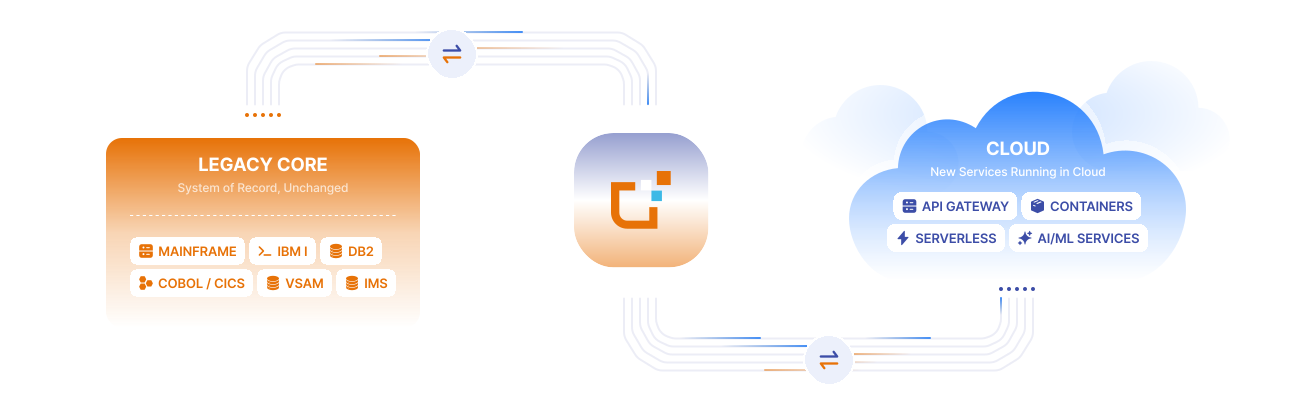
 Legacy and Cloud run in parallel. Workloads shift in waves. The core stays stable throughout.

External Decoupling
Create a new API layer — without touching the core. Expose existing production data, order management functions, inventory records, and supply chain information from legacy ERP and MES systems as modern APIs. IoT platforms, digital twins, B2B portals, and supply chain analytics tools consume these APIs while the legacy system remains the operational system of record. This is the fastest path to supply chain visibility, B2B portal enablement, and IoT integration.

Internal Decoupling
Selectively modernize modules — while keeping the whole system running. Identify and isolate specific operational functions — a production scheduling rule, an order pricing engine, a quality inspection workflow — so they can be exposed, decoupled, and progressively modernized while the existing system keeps running. Each phase reduces technical debt and operational dependency on the legacy environment at a pace that does not risk production continuity.

Data Layer Decoupling
Unlock legacy data for AI, analytics, and IoT platforms. Make operational data from legacy ERP and MES databases available to cloud data lakes, streaming layers, and analytics platforms without schema changes or ETL complexity. Predictive maintenance models, digital twin platforms, supply chain analytics tools, and OEE dashboards gain timely access to the production data they need from legacy systems of record.
Securely connect to IBM i, ERP, MES, or legacy system. Visualize dependencies, data structures, and integration points to identify the safest decoupling opportunities before any operational changes are made.
Map your modernization or integration plan. AI-powered automation identifies the APIs and data feeds needed to support the target architecture and builds the service blueprint — without manual reverse-engineering or specialist legacy skills.
Auto-generate the services and data feeds identified in the plan. Deploy to cloud, on-premises, or hybrid environments. Each phase delivers value without waiting for a full program to complete. Modernization becomes a continuous practice, not a one-time project.
Proven Across Manufacturing and
Industrial Operations
Manufacturing and industrial enterprises across the Americas and Asia use OpenLegacy to connect their legacy IBM i, ERP, and SAP environments to modern cloud platforms — delivering real-time order management, quality control integration, and operational data access without replacing the core systems that run production.
-May-27-2026-07-11-57-8529-AM.svg)
Grupo Herdez
IBM i order handling connected to Google Cloud — within a day
Grupo Herdez is a leading Mexican company in the processed food sector and one of the main players in the ice cream category in Mexico. The company is also the fastest-growing Mexican food brand in the United States, running large-scale IBM i (AS/400) environments to manage orders, production, and logistics across its operations.
Grupo Herdez needed to connect their IBM i (AS/400) system to the cloud to support modern order handling workflows. The requirement involved exposing multiple legacy functions — RPG programs, CL procedures, and DB2 stored procedures — as cloud-native services. Previous efforts to establish this connectivity had failed entirely, leaving order management workflows siloed and unable to benefit from cloud-based orchestration and analytics.
OpenLegacy's standard IBM i connector was used to expose the legacy functions as cloud-native services, with automated generation of services from input metadata. The solution was deployed directly to Google Cloud using Application Integration by Google alongside OpenLegacy's APIs. No specialist legacy skills were required beyond the team already in place.
"OpenLegacy and Application Integration by Google is the most efficient solution to unlock and leverage our IBM i core." — Grupo Herdez

JSW Steel
Real-time error detection and SAP Quality Control integration for a global steel manufacturer
JSW Steel is a multi billion-dollar Indian conglomerate and one of India's largest manufacturers, operating across the steel, energy, cement, and infrastructure sectors. As a major industrial producer, real-time data quality and operational error detection are critical to both production efficiency and cost management at scale.
JSW Steel needed to add error reporting and handling capabilities to a decentralized data collection system running across their manufacturing operations. The solution also needed to support seamless end-to-end data transfer to integrate the SAP Quality Control module, a critical requirement for maintaining production standards and regulatory compliance. Finding specialist resources to bridge legacy and modern systems was an additional constraint.
OpenLegacy was used to automatically generate microservice-based APIs to encapsulate data transfer across the decentralized system. The platform also generated Java code for error detection and handling — enabling the team to implement the integration using in-house developers working with open, standard technologies rather than requiring scarce specialist skills.
"As a major manufacturer, error detection is incredibly important not only for efficiency but also the bottom line. OpenLegacy had an innovative solution that also utilized open standards which also helped alleviate challenges finding the right skills and resources." — JSW Steel
Built to Work With Your Cloud
and Technology Partners
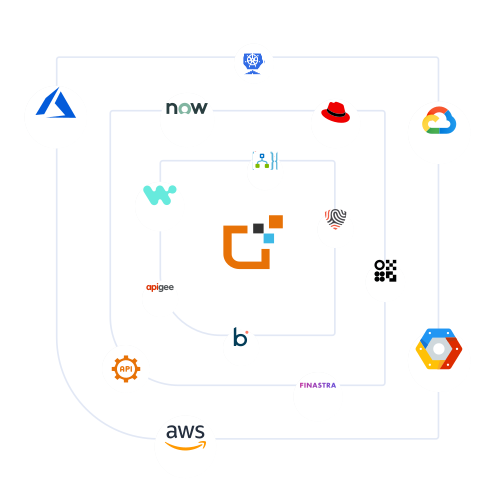
OpenLegacy integrates into modern cloud environments and works alongside the platforms manufacturing organizations already rely on. Whether you are connecting IoT sensor data to legacy MES context, integrating supply chain platforms with legacy ERP records, or building a B2B portal on top of legacy order management — OpenLegacy fits
into your architecture and delivery model without replacing the operational systems you depend on.
It complements modernization programs led by cloud providers and systems integrators, fitting alongside existing ERP migration and
Industry 4.0 programs rather than competing with them.