What's Holding Financial Services Back
The pressure to modernize is real. So is the risk of getting it wrong. Many financial institutions have tried — and been burned
by — middleware layers, costly rewrites, and big-bang migrations that stalled, overran, or failed. The core systems are not
the problem. The problem is modernizing them without a safe way to decouple, coexist, and move in phases.

Enable digital and mobile banking
Expose core banking logic as standards-based APIs in minutes, not months. No changes to the underlying system required. Digital channels gain real-time data access without workarounds.

Meet Open Banking & regulatory requirements (PSD2, GDPR, CCPA)
Auto-generate standards-based APIs directly from COBOL, CICS, VSAM, IMS, and IBM i assets to support Open Banking and related compliance initiatives. Deliver modern interfaces from core systems without adding another long integration project.

Faster time-to-market with new digital products
AI-driven automation reduces the time and effort required to turn legacy assets into reusable services. Teams can accelerate new digital initiatives without depending entirely on scarce legacy specialists.

Enable AI and data-driven personalization
Some of your most valuable data and business rules still live in legacy systems. OpenLegacy unlocks it — feeding AI models, analytics platforms, and personalization engines with real-time core system data.

Modernize payments and enable real-time processing
Decompose monolithic payment workflows into independent, API-first microservices. Support instant payment rails and new payment schemes without rebuilding your entire stack.

Reduce infrastructure cost and mainframe MIPS spend
Direct connectivity can reduce dependency on heavy middleware and help shift selected workloads into cloud-native deployment. This can reduce MIPS consumption and shift investments from maintenance toward modernization.
Proven Results. Real Banks

Faster Time-to-Market
Rapidly launch new digital services by connecting directly to your core — mainframes, IBM i, databases, or packaged applications — without changing the systems underneath.

Cost Reduction
Reduce development effort through automation and direct connectivity, helping teams deliver modernization outcomes with less manual work.

Big Bang Rewrites
Safely decouple legacy speed from digital innovation cycles without disrupting core systems.
Where OpenLegacy Delivers Value
Initiatives where legacy systems become bottlenecks — and where we create the
safest path forward.

Core Banking Modernization
Modernizing a monolithic core banking platform doesn't have to be an all-or-nothing program. Expose existing COBOL and CICS logic as APIs so domains like lending and payments can be decoupled in phases. Workloads shift in controlled waves entirely without downtime.

Open Banking API Factory
Auto-generate standards-based APIs directly from COBOL copybooks, CICS transactions, and IBM i programs. Move from bespoke integration to a repeatable API factory. Bank Leumi went from COBOL to microservices in 5 minutes, delivering 8 per week with 1 developer and 100% compliance.

Real-Time Payments
Adapt batch-based COBOL flows for 24/7 instant payment initiatives. Expose CICS and MQ entry points as event-based services while the core ledger remains. Banorte achieved a 20x faster API lifecycle, eliminated their ESB dependency, and met real-time SLAs.

Digital Lending
Expose lending functions like eligibility checks, scoring, and approvals as APIs without modifying core code. Support modern digital credit journeys where orchestration and AI-driven decisioning can natively evolve to ensure higher approval rates.

Fraud & AI Enablement
Fraud models and AI services need timely access to transaction data locked in legacy VSAM files and DB2 databases. Make that data available live, with lower latency than traditional middleware, so risk analysis and models can operate in true real-time.
How OpenLegacy Works With Your Core Systems
Your core doesn't need to be replaced to deliver modern services. OpenLegacy connects directly to
mainframes, IBM i, COBOL/CICS, VSAM, IMS, and DB2 and generates cloud-ready APIs and services to
decouple safely from what already exists. Modernization happens in controlled phases, with legacy and cloud
running in parallel until you're ready to shift workloads permanently.
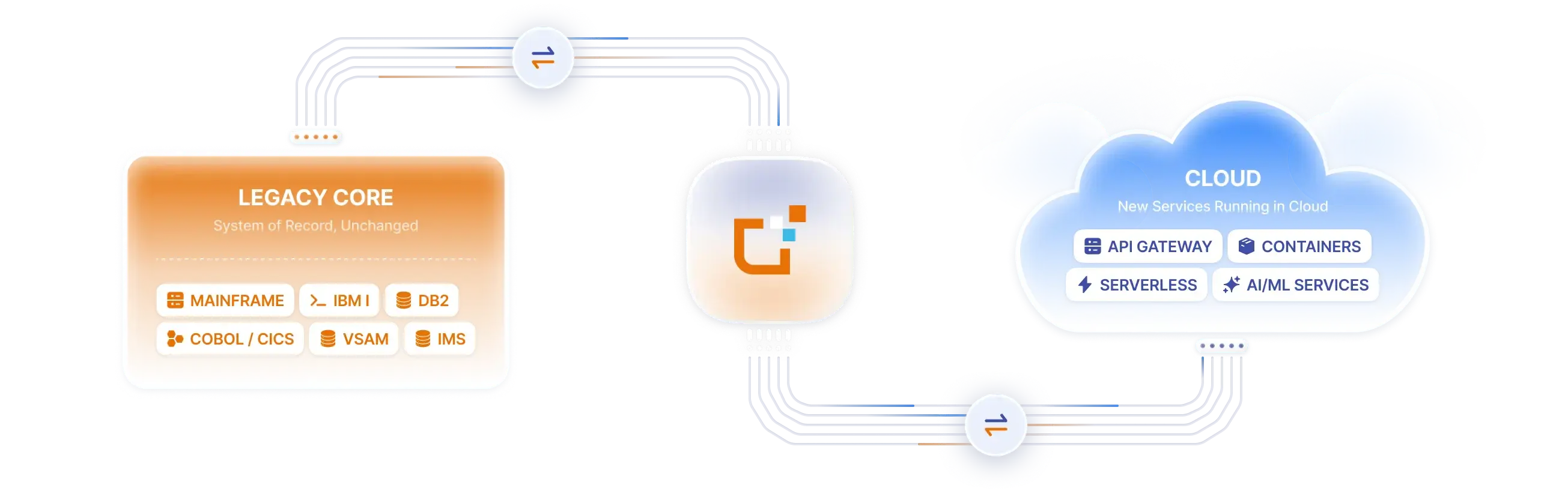
 Legacy and Cloud run in parallel. Workloads shift in waves. The core stays stable throughout.

External Decoupling
Create a new API layer — without touching the core. Expose existing mainframe transactions, programs, and data as modern APIs. Digital channels, partners, fintechs, and new cloud applications consume modern APIs while the legacy system remains the system of record. This is the fastest path to Open Banking initiatives, digital channel enablement, and reducing dependency on ESB-heavy integration.

Internal Decoupling
Selectively modernize modules — while keeping the whole system running. Identify and isolate specific business functions — such as a payment validation rule, a lending eligibility check, or a fraud scoring routine — so they can be exposed, decoupled, and progressively modernized while the existing system keeps running. New functionality can then be deployed independently, reducing risk and allowing technical debt to be addressed in waves.

Data Layer Decoupling
Securely connect to mainframe, IBM i, or legacy system. Visualize dependencies, transaction flows, and data structures to identify safe decoupling points before modernization begins for the specific project or phase.
Map your modernization plan. AI-powered automation identifies the integrations needed to support the safe decoupling pattern and builds the service blueprint — without manual reverse-engineering or specialist legacy skills.
Auto-generate the services identified in the modernization plan. Deploy to cloud, on-premises, or hybrid environments. Iterate continuously — each wave builds on the last. Modernization becomes a practice, not a project.
Trusted by the World's Leading Financial
Institutions
Banks across multiple regions use OpenLegacy to unlock their core systems, meet compliance
deadlines, and deliver new digital services without the risk of traditional modernization.

Bank Leumi
Generating microservices from mainframe in 5 minutes - to meet Open Banking compliance requirement
Urgent Open Banking compliance requirement to expose legacy assets. Creating OpenAPI specs from COBOL manually was too slow and required specialist knowledge the team did not have in-house.
Implemented OpenLegacy Hub with a CICS adapter to automate the entire microservice creation flow. Auto-generates microservice and OpenAPI file with direct deployment to cloud container environment eliminating the manual bottleneck
"The strategy is to not leave behind the mainframe but to empower it. Elevating it to a modernized world is why we partnered with OpenLegacy — it enables us to expose old legacy services and gain even further value from them without ditching them behind." — Eli Dotan, Group Manager, Middleware R&D and Operations, Bank Leumi

Banorte
Unlocking the high-value millennial market with streamlined digital experiences
Millennial onboarding was stalling due to ESB bottlenecks. Reliance on IBM and MCA middleware was slowing digital transformation and the team needed improved digital service performance without a core system rewrite.
Implemented OpenLegacy Hub to connect directly to the mainframe, eliminating the middleware bottleneck entirely. Direct connectivity replaced MQ and ESB layers with seamless integration into containers and modern orchestration platforms.
"Time to market isn't dealing with my backlog — it's when the market changes today, how do I react to it tomorrow." — Jose Andres Guillermo, Vice President IT, Banorte
-May-21-2026-05-47-50-2496-AM.svg)
Citi
Accelerating host-to-host implementation for global financial operations
Citi needed to accelerate complex host-to-host connectivity across global treasury and payment operations — connecting legacy infrastructure to modern digital banking services at speed and scale.
OpenLegacy provided the connectivity bridge between legacy host systems and modern cloud-based services, enabling fast, reliable host-to-host implementation without disruptive core changes.
Built to Work With Your Cloud
and Technology Partners
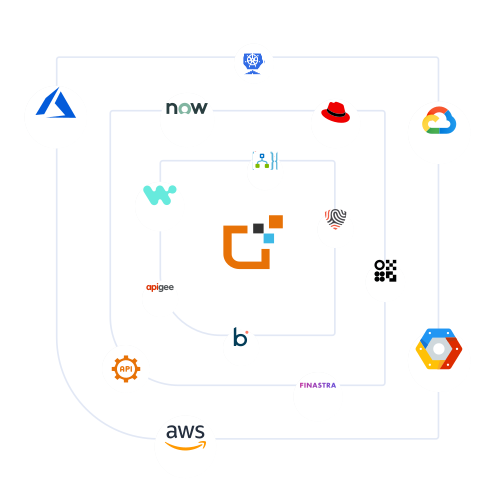
OpenLegacy integrates into modern cloud environments and works alongside the tools your teams already rely on. Whether you are pursuing a cloud migration with a hyperscaler, extending a core banking platform, or connecting fintech partners via an API gateway — OpenLegacy fits into your architecture and delivery model.
It also complements modernization programs led by cloud providers and ISVs, fitting alongside existing migration toolchains rather than replacing them.