

Modernizing Access
Gateways — Zero UI Disruption
External Decoupling keeps existing channels and integrations calling CTG, MQ, IMS,
and database endpoints exactly as before throughout the modernization
transformation journey
Why External Decoupling Matters
In many enterprises, external apps and channels connect directly to legacy technologies such as
CTG, MQ, IMS, or shared databases. That makes those integration points fragile: any change in the
backend risks breaking consumers, and modernization options become limited.
Even if you move these gateways or databases to the cloud, the tight coupling remains - consumers
are still bound to legacy interfaces and protocols.
External Decoupling changes the game:

Protects consumers and channels
Web, mobile, partner apps, and ESBs continue to “call CTG/MQ/DB” as they do today. No UI changes, no contract churn.

Enables invisible modernization
Core systems can be rehosted, refactored, or replaced behind the scenes while traffic is bridged to new services

Reduces migration risk
You can cut over specific flows and queues gradually, with controlled rollback.

Builds future flexibility
Once transition is complete, legacy gateways can be retired without forcing changes on upstream apps
Where Internal Decoupling builds a bridge inside the application, External Decoupling builds a bridge at the edge between
existing access gateways and your modern cloud services so you get zero UI disruption and full continuity
What Is the External Decoupling Pattern?
External Decoupling is a modernization pattern that redirects existing CTG, MQ, IMS, or database
traffic into modern cloud services without changing user-facing channels or integrations.

In practice:
- External apps continue to use their existing connection methods (CTG program calls, MQ queues, DB endpoints).
- An Interceptor sits in front of those endpoints and forwards requests to an OpenLegacy bridge, which exposes modern services (for example, Java APIs running on Kubernetes).
- To each external app, it still looks like it’s calling CTG/MQ/DB—only the actual execution has moved.

This delivers:
- Stability on the outside – No rewrites for existing consumers.
- Flexibility on the inside – Business logic can be rehosted, refactored, or replaced incrementally.
- A clear modernization bridge – Once enough flows are migrated, legacy gateways can be phased out safely.

Step‑By‑Step Implementation with
OpenLegacy Hub

AS-IS State
External systems are tightly coupled to legacy endpoints

Planning
Modernization Planner identifies which gateway traffic to redirect to modern services

The Gap
Modernizing the backend alone breaks existing connections—without a bridge

The Bridge
OpenLegacy generates adapters that transform and reroute legacy traffic

End-State
Legacy channels remain online while the backend modernizes seamlessly.
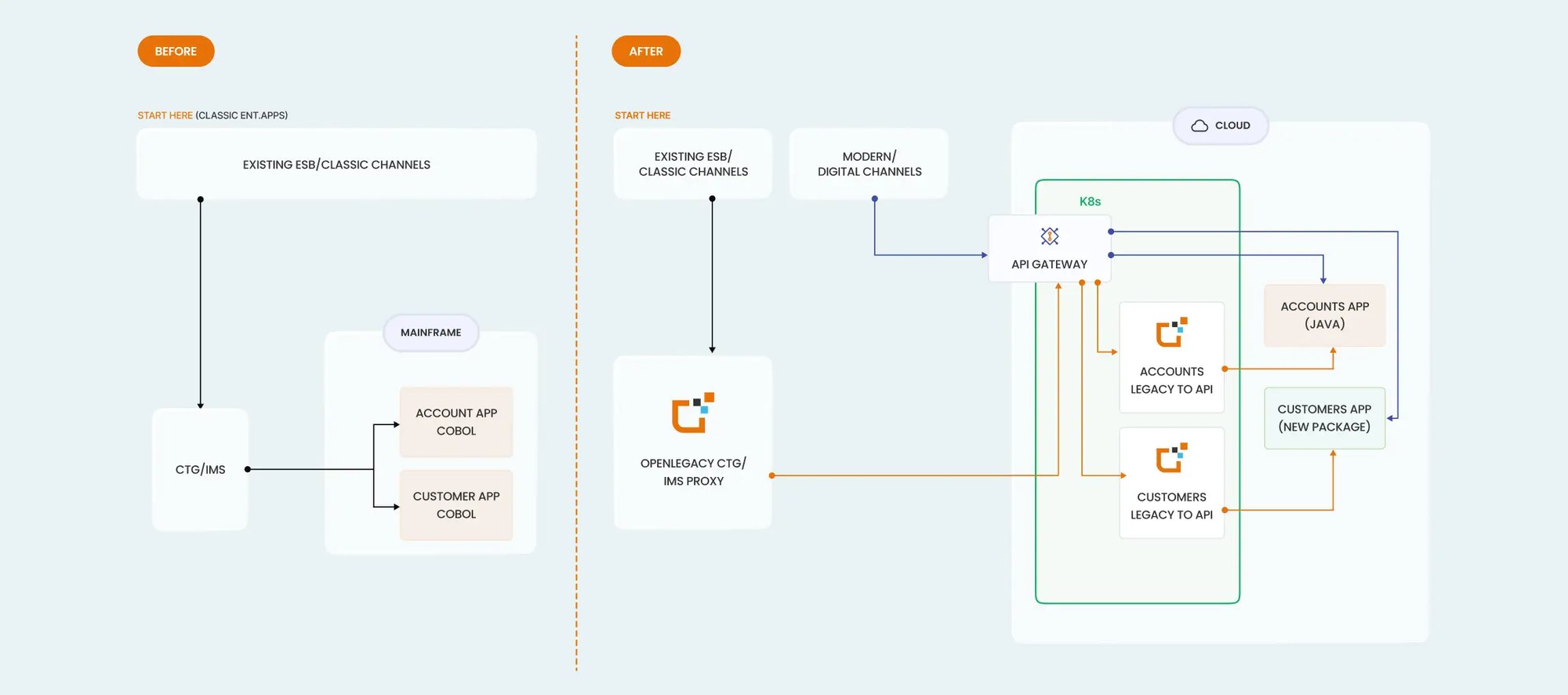
Keep the connections. Modernize the core.
How External Decoupling Works with
OpenLegacy Hub
External Decoupling isn’t just an architecture pattern; OpenLegacy Hub
automates it end-to-end.

Discover Gateway Traffic
- Modernization Planner and Analyzer auto-detect CTG programs, IMS routes, MQ queues, and direct DB connections, plus their payload schemas and usage.
- You see which external systems depend on which gateways and what traffic they carry.
A clear map of gateway dependencies and candidates for decoupling.

Planner Proposes Decoupling Plan
- Planner groups flows by domain (e.g., Accounts, Claims, Orders) and suggests where External Decoupling should be applied first.
- You review priorities (“start with partner APIs” or “start with portals”) and approve waves.
An incremental, domain-driven External Decoupling roadmap.

Integration Studio Generates Assets
- One click creates: listener stubs for MQ/CTG, payload mappers, and secure REST endpoints.
- Policies enforce naming, security (TLS/OAuth2/JWT), and deployment standards automatically.
A concrete, generated bridge between gateways and modern services.

Deploy Adapter & Refactor Logic
- The OpenLegacy adapter runs where you need it: z/OS USS, Linux on Z, or Kubernetes.
- Modernized services (e.g., Java microservices) are developed and deployed independently in your cloud of choice.
Legacy gateways feed modern services without changing external call patterns.

Cut Over Incrementally
- Use routing rules and traffic splitting to gradually redirect % of messages or calls from the legacy core to new services.
- If KPIs dip, simply re-point traffic back to COBOL/legacy logic
Controlled, reversible cutovers—no “all-or-nothing” switch.

Observe & Harden
- Built-in metrics, tracing, and audit logs feed your existing DevSecOps stack (APM/logging tools).
- You tune, harden, and decommission legacy endpoints once traffic has migrated.
A repeatable External Decoupling approach you can apply to additional gateways and domains
How OpenLegacy Removes the Risk
with External Decoupling
OpenLegacy eliminates integration risks by safely exposing APIs and services using proven patterns and automated tooling.

No channel disturbance
5250/3270, IVR, and batch jobs keep working unchanged.

AI‑assisted automation
Adapters and tests generate in minutes rather than weeks.

Structured rollback
Simply re‑point the gateway to the COBOL core if needed.

Enterprise‑grade security
TLS, OAuth2, field‑level encryption, audit logs

Ready to modernize external gateways with zero UI disruption?
Redirect CTG, MQ, IMS, and database traffic to modern cloud services while all channels and
integrations continue to work as-is—with no rewrites, no downtime, and controlled cutover
Key Benefits at a Glance

65% faster migration
Migrate backend systems
much faster than channel-first rewrites.

Zero ui changes
Employees and partners experience no interruptions
during migration.

40% lower TCO
Significantly cut costs by gradually retiring unnecessary middleware layers.

Cloud-Ready from Day 1
Instantly usable by AI, ML, and other innovations through secure APIs.
Net result:
You can start integrating modern systems, APIs, or external innovations immediately—your decoupled external services are fully operational, secure, and ready for immediate use from day one.
How External Decoupling Works with
other Decoupling Patterns
External Decoupling is one part of a broader, pattern-driven modernization strategy:

Data-Layer Decoupling
Extract data access into dedicated data services so you can move from legacy databases to modern, cloud data platforms
.png?width=100&height=100&name=Frame%20(1).png)
Internal Decoupling
Modernize internal modules (e.g., Accounts, Claims) one at a time while keeping internal program calls working via generated proxies.
Together they provide

Internal Decoupling
keeps modules talking

Data-Layer Decoupling
keeps data accessible and governable
-4.svg)
External Decoupling
keeps channels stable

Ready to Modernize Gateways with
Zero UI Disruption?
External Decoupling with OpenLegacy Hub lets you keep every channel online while you redirect CTG, MQ, IMS, and database traffic to modern services in the cloud. You protect users and partners, reduce migration risk, and create a cloud-ready backend that’s ready for AI, analytics, and whatever comes next.