

Modernizing Legacy Systems
One Module at a Time
Internal Decoupling transforms hidden program-to-program calls in mainframe and IBM i
systems into managed service contracts, letting you move modules to the cloud without halting
the rest. Modernization Planner finds safe decoupling points; Integration Studio creates reverse
APIs and proxies to keep everything synced
What Is the Internal Decoupling Pattern?
In many mainframe and IBM i applications, domains communicate through binary in-process calls (sub-programs,
copybooks, shared routines). These are efficient, but they lock modules together—preventing you from moving
just one part of the system to the cloud without rewiring everything.

How Internal Decoupling Works
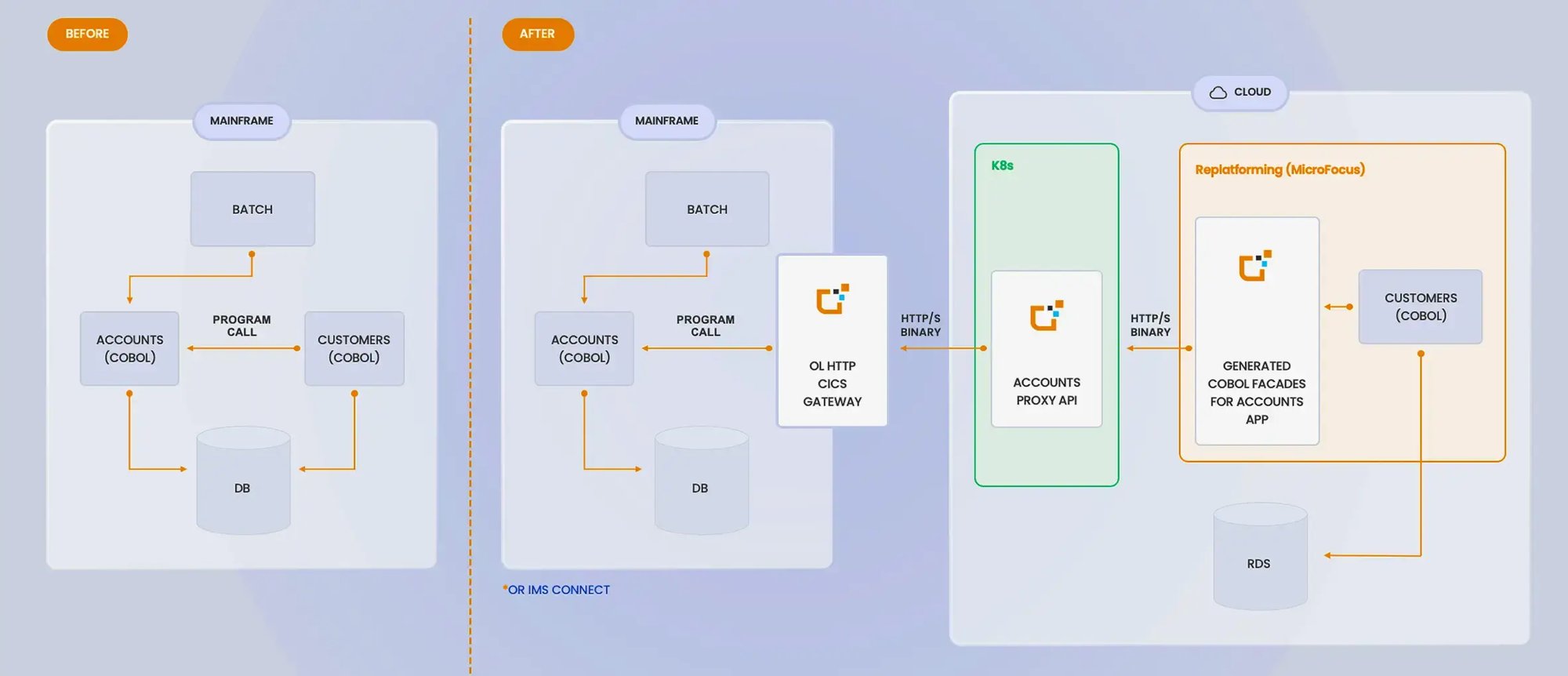
Internal Decoupling replaces those direct calls with remote service contracts generated by OpenLegacy Hub:
- The original caller (for example, Customers (COBOL)) still “thinks” it’s invoking a local routine
- OpenLegacy injects a generated proxy/interceptor that forwards the call over a secure remote interface to the modernized implementation (for example, Accounts (Java) running in the cloud).
- If needed, the modernized service can also call back into remaining legacy programs through the same pattern

From the architect’s point of view
- Inside calls become explicit, observable contracts across a bridge between mainframe and cloud
- Inside calls become explicit, observable contracts across a bridge between mainframe and cloud
- Coexistence is built in—legacy and modern modules continue to work together as you move functionality in waves or phases

When to use Internal Decoupling
- You need to migrate or rewrite one domain (e.g., Accounts, Customer, Claims) ahead of the rest
- Long-running batch jobs depend on shared routines that are moving to the cloud
- A new cloud service needs to reuse logic that still runs on the mainframe, without duplicating it
Step‑By‑Step Implementation with
OpenLegacy Hub

Analyze & Visualize Internal Calls
Use Hub Planner to scan application sources (e.g. COBOL), batch JCL, and DB2 calls. Identify the internal call graph and safe decoupling boundaries.

Generate Integration Factory Assets
Hub automatically creates and executes the plan, generating the required artifacts. Components are modernized on platforms such as BluAge.

Refactor / Rewrite Target Module
Refactor logic to Java / Spring‑Boot (or chosen stack) using generated clients for legacy APIs; mainframe apps access modules via reverse proxy

Deploy in Phased Co‑existence
Deploy modern modules via CI/CD and legacy proxy via mainframe procedures; communicate over HTTPS/MQ or supported protocols

Observe and Optimize
Built-in telemetry feeds observability tools (Prometheus, Grafana, CloudWatch) for tuning, gradual traffic shifts, and retiring old code
How OpenLegacy Removes the Risk
OpenLegacy's approach eliminates traditional modernization risks through proven patterns and automated tooling

No middleware lock-in
Direct, native connectivity (CICS, IMS, RPG) eliminates ESB overhead.

AI‑assisted automation
Reverse APIs, data models, and tests are generated in minutes, not weeks

Structured roll‑back
If something misbehaves, simply point the proxy back to the original program call

Security & Compliance baked‑in
OAuth 2, JWT, field-level encryption, audit trails. Enterprise-grade security is built into every integration layer, ensuring compliance with industry standards and regulations.

Agile approach
Supports phased approach versus big bang with built-in co-existence. Modernize incrementally while maintaining full operational stability, allowing old and new systems to work seamlessly together.

Ready to remove modernization risk from your strategy?
Discover how OpenLegacy's risk-free approach can accelerate your legacy
modernization journey with confidence and control.
Typical Industry Use Cases for
Internal Decoupling

Banking
Move a customer or account management module to the cloud while keeping dependent COBOL routines and batch jobs on the mainframe. OpenLegacy’s proxies keep both ends talking without breaking existing account processes.

Insurance
Refactor or rehost a claims engine, but keep call-center desktop apps and policy systems intact. Internal calls are redirected through OpenLegacy interceptors, so agents see no change in their tools

Retail
Modernize order processing or inventory as cloud services while legacy systems handle settlements and reporting. Decoupling bridges interactions so daily operations continue as normal

Manufacturing & Supply Chain
Move production scheduling or supplier collaboration to cloud platforms while ERP-style functions stay on mainframe. Internal Decoupling preserves the exchange of orders, status, and inventory across the bridge

Cross-Industry
Any organization that wants to modernize one business module at a time instead of rewriting entire monoliths can use Internal Decoupling as a safe on-ramp
Key Benefits at a Glance

70% faster migration
Move individual modules significantly faster compared
to manual rewrites.

Zero unplanned downtime
Cut over safely without
disrupting critical business
operations.

45% lower TCO
Reduce costs by eliminating middleware and duplicate batch processes.

Cloud- and AI-ready
Expose legacy capabilities immediately via secure APIs for AI/ML, analytics, and new services.
Net result:
You don't have to finish a multi‑year migration before your teams can start experimenting with AI/ML, real‑time analytics, or future innovations—the decoupled slice of your legacy estate is ready on day one.
How Internal Decoupling Works
with Other Patterns
Internal Decoupling often pairs with other decoupling patterns as part of a holistic strategy:

Data-Layer Decoupling
Once internal calls are decoupled, it’s easier to separate data access so modernized modules can connect to cloud or hybrid data sources without embedded SQL changes

External Decoupling
Combine internal modernization with gateway transformations, ensuring both internal and external traffic are routed through governed contracts as systems evolve.
Together they provide

Internal Decoupling
keeps modules talking

Data-Layer Decoupling
keeps data accessible and governable
-4.svg)
External Decoupling
keeps channels stable

Ready to break internal coupling —without breaking your business?
Internal Decoupling with OpenLegacy Hub gives you a safe, automated bridge between legacy modules and modern implementations. You can modernize critical functions one module at a time, keep operations running, and be ready for cloud, data, and AI from day one.