What is Modernization Planner?
Modernization Planner is a structured environment for defining, organizing, and managing modernization initiatives
across complex legacy estates. It gives you an end-to-end view of your mainframe and IBM i landscape, ties that
view to business priorities, and produces actionable, phased roadmaps your teams can actually execute.
Unlike generic planning tools, Modernization Planner is purpose-built for legacy modernization:

End-to-end visibility:
Connects to deep legacy analysis so your plans are based on real code, jobs, and data—not assumptions.

Actionable, data-driven roadmaps
Auto-structures tasks and phases around actual dependencies and chosen strategies (refactor, rehost, wrap, etc.).

Risk-aware and incremental
Supports micro-decoupling and phased execution, so you modernize in safe, testable steps instead of “big bang” cutovers.

Collaboration-ready
Provides a shared workspace for architects, product owners, analysts, and engineering teams to work from a single source of truth.
Who it's for:

Enterprise & Solution Architects

Technical Product Owners / Program Leads

Business Analysts & Transformation Teams
What You Can Do with
Modernization Planner
Modernization Planner turns legacy analysis into concrete next steps. From the first baseline
visualization to the last modernization wave, everything is structured and traceable.

See Your Legacy Landscape Clearly
Visualize programs, jobs, files, and databases as an interactive dependency graph, with filters by domain, technology, or business function.

Scope the Right Modernization Domains
Select applications or domains (e.g., Customer, Claims, Billing), then define strategies like refactor, rehost, wrap, or retire.

Generate Phased Roadmaps Automatically
Convert scoped domains into organized plans: waves, sprints, tasks, and dependencies that teams can immediately work against.

Model Scenarios & Impacts
Compare “what if” strategies (e.g., refactor vs. rehost) and see how each affects scope, risk, and effort before committing.

Collaborate Across Roles
Use a shared, role-aware workspace to align architects, business owners, and engineering teams on priorities and timelines.

Drive Execution with Confidence
Hand plans off directly to Modernization Executor and DevOps pipelines for controlled, traceable implementation.
How Modernization Planner Works
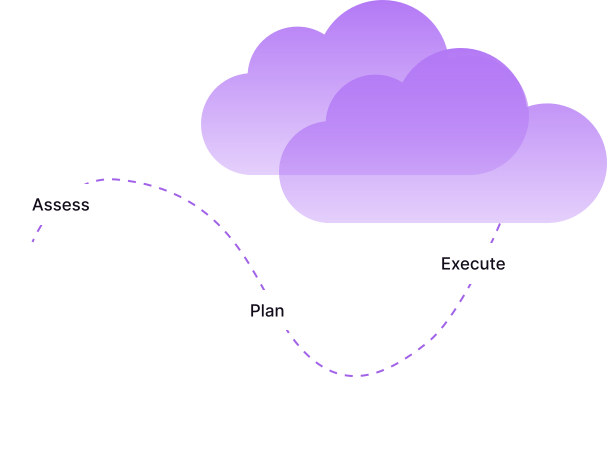
Modernization Planner guides you through a structured workflow — from
understanding what you have to executing change in a controlled way.

Import & baseline
Ingest metadata from mainframe, IBM i, and other legacy repositories (COBOL, RPG, JCL, DB2, etc.).
Establish a visual baseline of your system: applications, programs, files, databases, and their relationships.

Analyze Dependencies
Automatically map inter-program, job, and data dependencies.
Explore the system using interactive graph views to surface hidden coupling and risk hotspots.

Define the Plan
Select the applications or domains you want to modernize.
Assign modernization strategies (e.g., rehost, refactor, wrap, decommission) based on technical complexity and business value.

Structure Tasks & Phases
Auto-generate task lists tied to real components (programs, tables, jobs).
Group work into phases/waves, reorder priorities, and attach ownership.

Collaborate & Refine
Involve architects, product owners, and analysts to validate scope, dependencies, and business alignment.
Adjust the plan as new insights emerge; all changes are versioned and auditable.

Execute End-to-End
Trigger modernization actions (e.g., code transformations, deployments, tests) via Modernization Executor and integrated DevOps tools.
Track status and impact against the original plan, keeping everyone aligned on progress and risk.
Analyzer + Planner + Executor.
One Continuous Flow
Modernization Planner doesn’t start from a blank page and doesn’t end at a slide deck.
It’s part of a continuous loop that goes from understanding the legacy landscape to
executing modernization tasks.
Discovery & Understanding
Extracts and parses metadata from COBOL, RPG, JCL, DB2, and more. Builds the dependency maps and classifications the Planner uses as its baseline.

Strategy & Planning
Uses Analyzer output to scope, prioritize, and structure modernization waves. Produces visual plans and execution-ready task lists aligned with business goals.

Transformation & Delivery
Executes the tasks defined in the Planner: rehosting, refactoring, wrapping, deployment, and testing. Keeps execution traceable and auditable, feeding status and telemetry back into the plan.

Where Modernization Planner
Delivers the Most Value
-3.svg)
Refactor a Core Banking System Without Breaking It
A bank wants to refactor customer and account management modules spread across thousands of COBOL programs and DB2 tables.
- Map dependencies to understand which programs touch core tables.
- Isolate the account maintenance domain and define a phased refactoring plan.
- Generate tasks for API extraction, parallel testing, and staged decommissioning.
- Execute with confidence—no surprises to critical operations.

Scope a Rehost Plan for an Insurance Claims Platform
An insurer wants to rehost specific parts of its IBM i–based claims platform to the cloud.
- Visualize RPG, DB2, and CL structures to see the full landscape.
- Select only the domains they want to rehost (e.g., claim initiation, lookup), excluding others like accounting.
- Auto-build a task list aligned to rehost strategy: export schemas, create service wrappers, prepare test plans.

Industries

Systems

Modernization Planner Within
the OpenLegacy Hub Suite
OpenLegacy Hub
Is your Legacy Modernization Platform — delivering structured, risk-aware, phased modernization.

Legacy Analyzer
Gives you deep technical insight into mainframe and IBM i systems.

Modernization Planner
Turns those insights into visual, phased, task-driven modernization roadmaps.

Integration Studio & Modernization Executor
Then implement the integration and transformation work defined in those plans.

Ready to Turn Legacy
Insight into a
Modernization Roadmap?
Modernization Planner gives you a clear, traceable path from
complex legacy landscapes to executed modernization outcomes —
without losing control, context, or compliance along the way.