What's Holding Retail Back
Retail moves fast — but the systems that hold inventory, pricing, order, and customer data often do not. The pressure to
deliver real-time omnichannel experiences, handle peak trading periods, and feed AI-driven personalization is real. The
bottleneck is usually not ambition. It is the gap between what the legacy system holds and how quickly modern services can
access it.

Real-time omnichannel inventory visibility
Expose inventory data from legacy ERP and IBM i systems as real-time APIs — so e-commerce, mobile, in-store, and fulfilment channels all work from a single, live source of truth. Eliminate overselling and buffer stock caused by batch-updated inventory feeds.

Seasonal scalability and peak trading performance (Black Friday, Cyber Monday)
Legacy systems running batch-based inventory and order processes cannot support sub-second response times during peak trading. OpenLegacy generates cloud-native services from legacy back-ends that can scale elastically with demand — without requiring changes to the core system.

Customer loyalty and personalization powered by AI
Loyalty programs and AI personalization engines need real-time access to purchase history, customer profiles, and inventory data locked in legacy systems. OpenLegacy provides that connection with lower latency than traditional middleware, enabling AI-driven recommendations and real-time loyalty status.

Supply chain and logistics visibility
Inventory and logistics data siloed in legacy ERPs cannot support real-time supply chain decisions. OpenLegacy connects supply chain platforms and analytics tools directly to legacy data sources — providing the real-time visibility needed to respond to demand shifts and reduce out-of-stock events.

ERP and SAP integration without custom middleware
Connecting modern cloud applications to existing ERP systems through custom middleware is slow, fragile, and expensive to maintain. OpenLegacy generates standards-based APIs directly from ERP and SAP data structures — enabling faster integration without bespoke connector development or middleware overhead.
-May-27-2026-09-17-19-3670-AM.svg)
Point of sale modernization and cloud transition
Legacy POS systems that depend on batch synchronization cannot support modern in-store experiences. OpenLegacy enables a phased POS modernization approach — exposing POS data and functions as APIs and progressively shifting workloads to cloud-native services without a disruptive cutover.
Connect Faster. Scale Further. Sell More.

Faster Time-To-Market
Deliver new digital commerce capabilities faster by connecting directly to legacy inventory, ERP, and order systems — without changing the systems underneath.

Cost Reduction
Reduce integration development effort through automation and direct connectivity — eliminating the custom middleware builds that slow every digital initiative.

Big Bang Rewrites
Safely bridge legacy ERP speed and real-time digital commerce needs. Legacy and cloud run in parallel — workloads shift in controlled phases at your pace.
Where OpenLegacy Delivers Value in Retail
These are the retail modernization initiatives where legacy systems create the most
friction — and where OpenLegacy removes it without disrupting the operations that
keep the business running.
-2.svg)
Real-Time Omnichannel Inventory Management
E-commerce, mobile, in-store, and third-party fulfilment channels all need to work from the same, live inventory position. But inventory truth lives in legacy ERP and IBM i systems that were built for batch processing — not sub-second API responses. OpenLegacy generates real-time APIs directly from these legacy inventory systems, providing all channels with a single, consistent source of stock truth. Overselling risk is eliminated, buffer stock is reduced, and fulfilment accuracy improves across every channel.

Seasonal Scalability & Peak Trading Performance
Black Friday, Cyber Monday, and other peak trading events expose the limits of legacy batch systems. E-commerce platforms need sub-second response times for availability checks and order placement — and the systems that hold that data need to scale elastically with demand. OpenLegacy generates cloud-native services from legacy inventory and order back-ends that can be deployed on cloud infrastructure and scaled independently of the core system, without requiring the core to be changed or re-architected.

Customer Loyalty & AI Personalization
Loyalty programs and AI recommendation engines need real-time access to purchase history, customer profiles, and live inventory data. This data is often stored in legacy systems and is only accessible via batch exports or slow middleware integrations. OpenLegacy connects AI and personalization platforms directly to legacy data sources with the low latency that real-time recommendations require — enabling loyalty point calculations, personalized offers, and next-best-action prompts to respond to what the customer is doing now, not what they did yesterday.

Supply Chain Visibility & ERP Integration
Supply chain visibility platforms, demand forecasting tools, and logistics systems all need consistent, real-time access to inventory and order data held in legacy ERP and IBM i environments. Custom connector builds are slow, fragile, and expensive to maintain. OpenLegacy generates standards-based APIs directly from ERP and SAP data structures — including IBM i and mainframe-hosted instances — enabling supply chain platforms to access the data they need without bespoke integration work and without changing the core ERP.

Point of Sale Modernization & Cloud Transition
Legacy POS systems that depend on nightly batch synchronization to the back office cannot support modern in-store experiences — mobile checkout, clienteling tools, real-time loyalty redemption, or unified cart across channels. OpenLegacy enables a phased POS modernization approach: exposing POS data and functions as APIs first, progressively shifting in-store workloads to cloud-native services, and enabling digital twin patterns where IoT and in-store sensors can reference real-time legacy inventory data — all without a disruptive POS replacement program.
How OpenLegacy Works With Your Core Systems
Your ERP, IBM i, and legacy inventory systems do not need to be replaced to power modern retail experiences.
OpenLegacy connects directly to these systems and generates cloud-ready APIs and services from what already
exists. Digital and legacy run in parallel — you choose the pace.
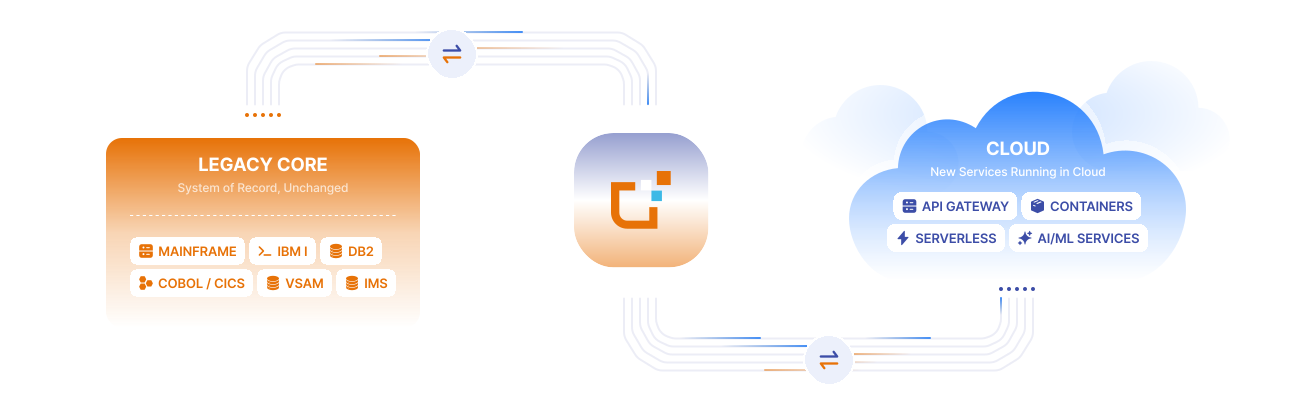
 Legacy and Cloud run in parallel. Workloads shift in waves. The core stays stable throughout.

External Decoupling
Create a new API layer — without touching the core. Expose existing inventory, order, pricing, and customer data from legacy ERP and IBM i systems as modern APIs. E-commerce platforms, mobile apps, supply chain tools, and AI services consume these APIs while the legacy system remains the system of record. This is the fastest path to real-time omnichannel inventory, loyalty integration, and ESB retirement.

Internal Decoupling
Selectively modernize modules — while keeping the whole system running. Identify and isolate specific business functions — an inventory availability check, an order pricing calculation, a loyalty points engine — so they can be exposed, decoupled, and progressively modernized while the existing system keeps running. New cloud-native functionality deploys alongside the legacy system, reducing risk and allowing the modernization to progress in waves aligned to business priorities.

Data Layer Decoupling
Unlock legacy data for AI, analytics, and real-time services. Make data from legacy databases and ERP systems available to cloud data stores, streaming layers, and AI platforms without schema changes or middleware overhead. AI personalization engines, demand forecasting tools, supply chain analytics, and IoT systems gain timely access to the inventory, order, and customer data they need from legacy sources of truth.
Securely connect to IBM i, ERP, mainframe, or legacy system. Visualize dependencies, data structures, and integration points to identify the safest decoupling opportunities before any changes are made.
Map your modernization plan. AI-powered automation identifies the APIs and services needed to support the target retail architecture and builds the service blueprint — without manual reverse-engineering or specialist legacy skills.
Auto-generate the services identified in the plan. Deploy to cloud, on-premises, or hybrid environments. Iterate continuously — each wave builds on the last and delivers business value without waiting for a full program to complete.
Trusted by Leading Retailers and
Consumer Operations
Retailers and consumer-facing enterprises across Europe and the Americas use OpenLegacy
to connect their legacy systems to modern digital platforms — delivering real-time data, faster
catalog updates, and seamless supplier integration without replacing the core systems their
operations depend on.

Monoprix
From batch catalog updates to real-time in 45 days
Monoprix is a major French retail chain offering food, fashion, beauty, and home products across 700+ stores in France with a significant online presence. The COVID pandemic accelerated the urgency of their digital operations.
Monoprix was using batch and other legacy processes to update their online product catalog. Adding a new item or making a change to an existing listing took a full day to process. Resolving any issues with an update could take days. With new fashion collections requiring fast time-to-market and growing online traffic, the batch approach was no longer viable.
OpenLegacy exposed Monoprix's mainframe CICS transactions — alongside green screen and DB2-based processes — as APIs and microservices without adding technical layers. Rather than overhauling the legacy system, the integration moved from once-daily batch updates to near real-time catalog updates. Monoprix assumed full ownership of the project within 45 days of ramp-up.
"We needed to move to a more real-time information system in the exposure of our legacy reference data. Before OpenLegacy, the data was not available until the next day, with a batch integration approach. The OpenLegacy solution opened up our mainframe even more." — Emmanuel Lecomte, Lead Architect, Monoprix

Delek Motors
20% salesforce productivity improvement through IBM i to CRM integration
Delek Motors is a leading Israeli automotive retailer — an exclusive importer and distributor of Mazda, Ford, and Lincoln vehicles operating across 12 sales dealerships, a headquarters, and a central logistics center. As part of a broader digital transformation initiative, Delek sought to give its sales and customer care teams a complete, real-time view of the customer lifecycle.
When Delek acquired a BMW franchise in 2011, the CEO set a strategic goal to improve customer experience across the entire ownership lifecycle — from first dealership visit through vehicle purchase, post-purchase service, and trade-in. To achieve this, Delek needed a CRM system that could serve 120 users across its dealership network. The critical barrier was data: quotes, order details, logistics information, and customer care records all resided on an IBM i system, and the new CRM needed seamless, real-time access to all of it.
Delek selected Microsoft Dynamics as its CRM and used OpenLegacy to integrate it with their IBM i applications. Within three weeks, more than 120 IBM i application screens were incorporated into the CRM platform — with no changes to the underlying IBM i environment and all existing security and permission definitions kept intact. The full project, delivered with systems integrator Elad Systems, completed in three months: on time and under budget.
"The Microsoft CRM implementation is part of a bigger project at Delek to combine legacy applications with new technologies, offering our users uniform and friendly interfaces. OpenLegacy made the integration between the IBM i applications and the CRM fast and painless." — Ruth Hirsch, Deputy CIO, Delek Motors
Built to Work With Your Cloud
and Technology Partners
OpenLegacy integrates into modern cloud environments and works alongside the platforms retailers already rely on. Whether you are connecting a cloud-native e-commerce platform to a legacy IBM i inventory system, integrating AI personalization with ERP data, or bridging IoT in-store sensors to back-office stock records — OpenLegacy fits into your architecture and delivery model without replacing the systems you depend on.
It complements modernization programs led by cloud providers and systems integrators, fitting alongside existing ERP migration and cloud adoption programs rather than competing with them.