




TL;DR
- The board keeps asking why AI ROI is thin, and the honest answer is that the model is fine and the data feeding it is starving.
- The customer records, risk rules, and pricing logic your best use cases need have lived on the mainframe for decades, out of reach of your AI.
- A rewrite to reach them means months of risk before a single model improves, which is why so many AI initiatives stall.
- Exposing that data and logic to AI without a rewrite, using governed APIs and one business process at a time, feeds models now and keeps the core running.
- The same governed steps that feed AI carry you into full modernization, so legacy becomes your fastest path forward instead of your biggest blocker.
Your AI isn't underperforming. It's starving. The models are ready and the board is waiting, yet the use cases that would move the numbers sit in pilot, cut off from the data and business logic locked in your core systems.
The way out is governed access to what your mainframe already knows, its data and the decades of business logic wrapped around it. You can make your legacy your AI advantage, one business process at a time, without a rewrite and without betting the company.
Why your best AI use cases are starving
Your organization has put real money into AI. You have the models, the platform, and a board that expects returns. Yet the use cases that would move the numbers, a personalized loan offer, a change to a home insurance policy, a fraud alert that arrives in time to matter, sit stuck in pilot. In most of these programs the model works fine. What holds it back is the data it can reach.
Most enterprise AI never sees the data it needs. The records that matter sit in systems the model has no way to reach, so the use case stalls before it can prove itself. And where access does exist, it often runs on overnight batch exports, so a model scoring risk this morning reasons about yesterday's customer. Data that shows up late weakens a decision. Data that never shows up prevents one.
The pattern shows up across regulated banks and insurers. The data an AI needs most, the live transaction records and customer history, sits in legacy systems built over decades, on the mainframe and the AS/400, and reaches the outside world in batches if it reaches it at all. Deloitte drew the same conclusion in its 2026 State of AI in the Enterprise: legacy data and infrastructure architectures cannot power real-time, autonomous AI.
And the problem is widely shared. In MuleSoft's 2026 Connectivity Benchmark Report, 82% of IT leaders called integration one of the biggest challenges their organization faces when using AI, and 86% said that without proper integration, AI agents add more complexity than value. So the person who owns AI value, the Chief AI Officer answering to the board, ends up accountable for outcomes they cannot deliver, because they do not control the pipeline that feeds the models.
The shift in thinking is simple. The way to make your legacy your AI advantage is not a better model. It is governed access to the data and logic your models need. Feed them from the systems that already run the business, and the stalled use cases begin moving.
And the data is only half of what sits locked away. The logic that decides what the data means lives there too, and your AI cannot reach it either.
The data and logic your AI needs were built over decades
Ask most teams what their AI cannot reach, and they point to data. The records, the history, the transactions. But data is only half the story. The business rules that decide what the data means, who qualifies, what a policy covers, how risk gets priced, took shape in your core systems over 30 years and sharpened with every edge case since. Your AI needs those rules as much as it needs the data.
Think about what a single answer requires. A customer asks whether they can raise their credit limit for a trip. The data is the account, the balance, the payment history. The logic is everything that turns that data into a decision: the eligibility rules, the risk thresholds, the authorization limits your bank has tuned for decades.
A model with the data but not the logic can describe the customer. It cannot make the call the business would stand behind. A model with neither is guessing.
That logic lives where the data lives, inside COBOL programs on the mainframe and the AS/400, wrapped in conditions no one has documented in years. Reaching it has been the hard part. New access patterns like MCP are changing that. But a safe connection to core systems data and logic is still missing.
A real example: a credit-limit request
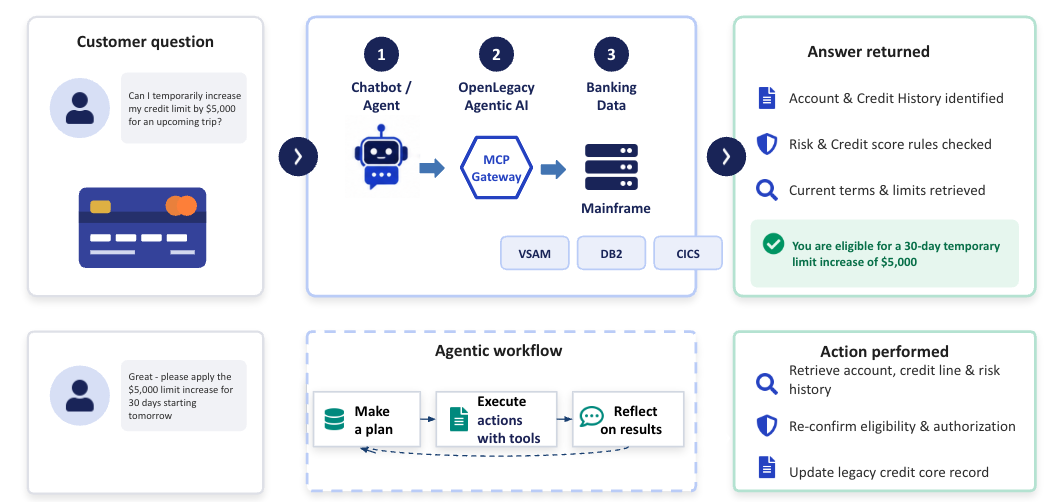
Figure: One question ("Can I raise my limit by $5,000?") depends on data and logic across VSAM, DB2, and CICS on the mainframe.
Let's walk through the request step by step. A customer asks, "Can I temporarily raise my credit limit by $5,000 for an upcoming trip?"
Your chatbot cannot answer on its own. The customer's record lives on legacy systems, across VSAM files, DB2, and CICS. An MCP gateway reaches in securely and pulls what the answer needs: account and credit history, risk and credit score, current terms and limits. Now the assistant can respond, "You are eligible for a 30-day increase of $5,000."
Then the customer says, "Great, apply it for 30 days starting tomorrow." Now the AI has to act, not only answer. An agentic workflow runs the steps a person would: retrieve the account, credit line, and risk history; re-confirm eligibility and authorization; update the legacy credit core record.
Every step depends on data and logic that live in the mainframe. Take that access away, and the whole workflow stops at the first question. The hidden blocker in your AI strategy is the legacy system your model cannot reach.
So the obvious move is to go get that data and logic out of legacy. And for as long as anyone can remember, getting it out has meant one thing: a rewrite.
Why the rewrite-first habit holds AI back
For decades, a rewrite was the only door in. If you wanted legacy data or logic in a modern system, you rebuilt or migrated it, then waited. The habit runs so deep it still shapes how most teams scope AI: modernize the core first, connect AI after. And that sequence is what stalls the AI.
The trouble is timing. A rewrite front-loads the risk and the delay. Months, sometimes years, pass before a single model sees fresher data, while the core keeps running the business without a stumble. Few AI programs survive that wait.
Gartner predicts that more than 40% of agentic AI projects will be canceled by the end of 2027, citing escalating costs, unclear business value, and inadequate risk controls. Senior Director Analyst Anushree Verma points out that most agentic projects today are early experiments driven by hype. Behind the hype sits a quieter problem: pilots that never got the live data and logic they needed to prove their worth.
There is a quieter cost too. A full rebuild asks a regulated bank or insurer to take on big-bang migration risk, the kind a CTO has spent a career avoiding, all to serve an AI goal in a different budget and team. So the project stalls in the gap between what the AI leader needs and what the CTO will approve.
Making your legacy your AI advantage means breaking the old link between access and rebuild. Reach the data and logic where it lives, under governance, and the value shows up in weeks instead of quarters.
So if a rewrite is the slow road, what does the fast one look like? It begins by exposing what AI needs, and leaving the core in place.
Expose, don't replace: make legacy AI-ready without a rewrite
There is a faster path, and it rests on a different assumption. You do not need to rebuild the core to let AI use it, only a clean, governed way to reach the data and logic already inside it. Expose what AI needs, leave the system running, and what you were about to spend two years replacing becomes what feeds your models next month.
OpenLegacy does exactly that. It exposes the data and business logic of a single business process as clean, governed APIs an AI can reach through an MCP gateway, the same pattern behind the credit-limit example earlier. The AI gets a contract it can read and trust across DB2, VSAM, CICS, and more.
There is no rebuild and no migration underneath, and the mainframe keeps running as it always has.
OpenLegacy also supports an agentic workflow that needs to access or to update your legacy systems. Using our no-code studio you can describe an agent, and the platform builds and deploys it in minutes. What it generates is ready for production immediately, not a prototype you have to harden later. Exposing and updating that clean contract instead of the raw system cuts the legacy context an AI or a developer has to reason over by up to 99%.
For a regulated bank or insurer, the governance travels with the data. Lineage and PII controls are built into the exposure rather than bolted on afterward. So the AI leader gets the live data and logic the models need, and the CTO gets a risk story they can approve, because the core never moves and never stops.
Feeding AI safely from legacy delivers value now. The same exposure that answered today's question can also carry you toward a modern core, on a timeline you set.
From AI-ready to fully modern, one business process at a time
Once a process is exposed and running through governed APIs, the same work that made it AI-ready has already begun modernizing it. You can hold there, or keep going, one business process after another, until the core itself is modern, at the pace your market sets.
The method is what makes this safe. OpenLegacy modernizes a single business process while everything around it keeps running. Risk-free coexistence means the mainframe stays live as the permanent fallback, so the risk of a big-bang cutover drops to zero. Old and new run side by side, and you cut traffic across only when you are ready.
For the CTO, that is the risk story they have wanted for years. For the AI leader, it is board-ready proof: value in production, not another pilot. The platform delivers up to 10x faster time-to-market and 60% lower cost per service than a traditional rebuild, changing the math on every process that follows.
The budget shift
A full modernization program reads as slow, multi-year capital spend the board keeps deferring. Feeding AI reads differently: operating spend that shows value in weeks, tied to outcomes the board already cares about. So early AI wins do more than prove the model. They build the business case, and free the budget, to modernize the next process.
That is how legacy turns from the thing holding your AI back into the thing moving it forward. The only question left is where to begin.
Feed your first use case from legacy
You do not have to fix everything to prove this. Pick one process where AI is stuck waiting on the core, the credit-limit request is a good candidate, and expose its data and logic through an MCP gateway. Give your AI live, governed access in production, and let one use case show the board what AI can do once it is finally fed.
See how OpenLegacy makes legacy data and logic AI-ready, and get a live use case running without a rewrite.
FAQ
What does "make legacy data AI-ready" actually mean?
It means giving AI governed, real-time access to the data and business logic inside your core systems, in a form a model can read and trust. The data stays where it is. Rather than a migration, you expose what AI needs through clean APIs, so models work from live information instead of stale exports.
Do we have to migrate off the mainframe to use AI?
No. Your highest-value data and logic can feed AI while the mainframe keeps running. OpenLegacy exposes a business process as governed APIs an AI reaches through an MCP gateway, with no rewrite underneath. You gain AI access now and decide later whether, and how fast, to modernize the core.
Is our business logic really needed for AI, or just the data?
Both. Data tells the AI what is true. The business logic decides what it means: who qualifies, what a policy covers, how risk gets priced. Rules refined over decades live in COBOL on the core. Without them, a model can describe a customer but cannot make the decision your business would stand behind.
How is this different from wrapping the mainframe in an API gateway or a tool like MuleSoft?
A gateway placed over the core still inherits its complexity and undocumented dependencies. OpenLegacy exposes a clean, governed contract for each business process, so the AI reads something simple and trustworthy across DB2, VSAM, and CICS. The result is access built for AI, rather than a thin layer over the same tangle.
Is exposing legacy data to AI safe for a regulated bank or insurer?
Yes, when governance travels with the data. Lineage and PII controls are part of the exposure, and risk-free coexistence keeps the mainframe live as the fallback. The core never moves, so the CTO keeps the continuity and audit story that regulators expect from a bank or insurer.
How fast can a first AI use case run on live core data?
Faster than a rebuild by a wide margin. OpenLegacy exposes a process as production-ready APIs and can build and deploy an agent from its no-code studio in minutes, delivering up to 10x faster time-to-market and 60% lower cost per service than a traditional modernization project.
Will AI-first spending count as OpEx instead of infrastructure CapEx?
Often, yes. Feeding AI from legacy is fast-moving operating spend tied to outcomes the board already funds, rather than a slow, multi-year capital project. Early AI wins tend to build the business case and free budget to modernize the next process, which reshapes how modernization gets paid for.
We’d love to give you a demo.
Please leave us your details and we'll be in touch shortly