



The best-performing businesses are 61% more likely to increase their investment in innovation than others. Many organizations, though, are held back by cumbersome legacy systems that prevent them from adapting effectively to an ever-evolving world. Hybrid cloud modernization can help you bridge the gap and move toward more futureproof, innovation-friendly infrastructure.
To understand whether a hybrid approach to modernization could be right for your business, you must first understand what it is and how it works. That’s precisely what you can do, right here.
Hybrid cloud modernization: key takeaways
- Hybrid cloud modernization is the integration of legacy on-premises systems with cloud-native services.
- By taking a hybrid approach to modernization, enterprises ensure their legacy systems can work within cloud environments.
- Phased coexistence of on-premises and cloud systems lets enterprises modernize their infrastructure at their own pace and with no disruption.
- OpenLegacy’s platform helps organizations achieve an agile phased modernization which is the ideal path to long-term digital transformation.
What is hybrid cloud modernization?
Modernization of legacy systems is imperative to organizations that want to survive and thrive in a world of continuous technological change. Cloud-native services and environments are the most futureproof alternatives, but how do enterprises with complex and business-critical on-premises legacy systems get there?
Definition and key concepts
Hybrid cloud modernization is the integration of legacy on-premises systems with cloud-native services. It helps organizations to make their legacy systems work within the cloud environment, and lets them migrate to a full cloud infrastructure on their own terms and within their own timeframes.
Of course, the term hybrid cloud can also refer to IT architecture combining public and private cloud environments. In this case, however, hybrid refers to the blending of on-premises and cloud systems in order to achieve agile and incremental modernization.
Why legacy systems still matter in the hybrid era
Cloud-native systems are best suited for the business world of today and, especially, for that of tomorrow. Many enterprises, however, have relied on legacy on-premises setups since long before that was the case.
While sticking with those systems permanently isn’t a truly viable option, full-scale digital transformation–especially of a “rip and replace” nature–is hardly more feasible. Such endeavors are expensive, risk significant downtime, and can feel like a waste of the investment already made in legacy infrastructure.
Hybrid cloud modernization is a crucial means of making those legacy systems work within the cloud environment. By doing so, your enterprise can achieve an agile phased modernization that overcomes the challenges of traditional “big bang” approaches.
How a hybrid cloud approach supports legacy modernization
Rip and replace approaches to cloud migration are typically expensive and laced with risk. The hybrid cloud alternative lets you modernize at your pace, spread the cost, and mitigate that risk. Application programming interfaces (APIs) and decoupling patterns are two key elements to enabling that agile phased modernization.
APIs, decoupling patterns, and agile phased modernization
Hybrid cloud modernization allows legacy systems to continue operating without disruption while some data, functions, and processes transform into cloud-native services.
APIs play a key role by exposing legacy data and allowing legacy functions to interact seamlessly with new digital services, with minimal code changes. Those APIs continue to function as you move forward in your modernization journey, minimizing the risks involved as you move toward full cloud migration.
Decoupling patterns are also crucial to agile, iterative modernization and are a critical advantage of OpenLegacy’s hybrid phased coexistence approach.
Proven strategies for separating often-monolithic legacy systems into more manageable parts, decoupling patterns mean enterprises can modernize each piece individually. They need only focus on what’s needed for the next step of their modernization journey, keeping critical systems running, and reducing both cost and risk.
The convergence of DevOps and legacy modernization
DevOps today moves at a rapid pace, with many pipelines taking a CI/CD approach to the software development lifecycle. An agile hybrid cloud modernization approach can help integrate legacy systems into those fast-moving pipelines.
Integration tools, like those offered by OpenLegacy, can ensure seamless integration of legacy components. That ensures modern and legacy systems work harmoniously together and can result in a shorter time-to-market for new features.
Industry use cases: real-world hybrid cloud modernization
The real-world positive impact of a hybrid approach to modernization is already being felt by many organizations, across varied industries.
Financial services
The banking and financial services industry has undergone a seismic shift in recent years. The rise of digital banking and consumers’ preference for it over in-branch interactions has created both challenges and opportunities.
Banks and other financial institutions have had to quickly look to digital transformation, and a hybrid approach often proves the most effective. Such a path allows them to retain secure core banking functions on-premises while benefiting from analytics and customer-facing apps rooted in the cloud.
Credicorp Bank, for example, recognized the need for digital transformation to harness new technologies that would support innovation in the short term and sustained growth in the long term. Their legacy core banking systems, however, were complex and slowed down the development and release of new products.
By working with OpenLegacy, Credicorp created a new technological platform for sustaining its digital transformation efforts. Underpinned by microservices architecture and APIs, the bank decoupled its services to gain greater agility. The result was a record time-to-market for Credicorp’s new services for customers.
Insurance
Insurance companies have also recognized the long-term advantages of transitioning to cloud environments. However, many also own data and applications they’d prefer to keep on on-premises mainframes, at least in the short term.
Once again, a hybrid cloud modernization approach is the answer to that conundrum, and can also significantly improve key systems like claims processing.
Legal and General is a world-renowned name in the insurance industry. It partnered with OpenLegacy to separate “softcore” ancillary systems, such as document management, from those considered “hardcore,” such as claims processing. The idea being to migrate the former to a modern environment, such as Microsoft Dynamics, while leaving hardcore systems on the mainframe.
Thanks to OpenLegacy Hub and the automatic generation of APIs to expose legacy data on the mainframe, Legal and General was able to adopt a harmonious hybrid architecture. The mainframe works together seamlessly with both private and public cloud on the digital side, streamlining processes and making the best use of each technology.
Manufacturing
In manufacturing, a hybrid cloud approach can help to connect crucial technologies like IoT devices, on-premises ERP systems, and more. That can create efficient, intelligent workflows which save businesses time and money.
Caterpillar International and its distributor Zoko Industrial Technologies, for example, turned to OpenLegacy to improve the efficiency of repair technicians on the manufacturing floor.
Zoko provided its technicians with a time-tracking IoT device to accurately monitor the time taken for repairs. Caterpillar, meanwhile, gave Zoko access to the source code and data from its ERP system, located on an IBM i platform. What they didn’t want, however, was for technicians to repeatedly log in to the on-premises system and enter their details.
In just three weeks, OpenLegacy built APIs to connect the IoT devices directly to the IBM i system. Zoko gained rapid data analysis capabilities that allow managers to give feedback on variations in normally accepted repair times for specific tasks, and ensure productivity.
OpenLegacy’s legacy modernization platform advantage
OpenLegacy’s AI-driven legacy modernization platform helps you to unlock the potential of your legacy systems with a phased, structured approach to modernization. That allows you to modernize on your terms, at your pace, and without risk.
Simplifying legacy modernization
With OpenLegacy, you can generate and deploy modernization-ready APIs automatically. There’s no complex middleware involved, and new cloud services can communicate natively with the on-premises legacy systems and applications.
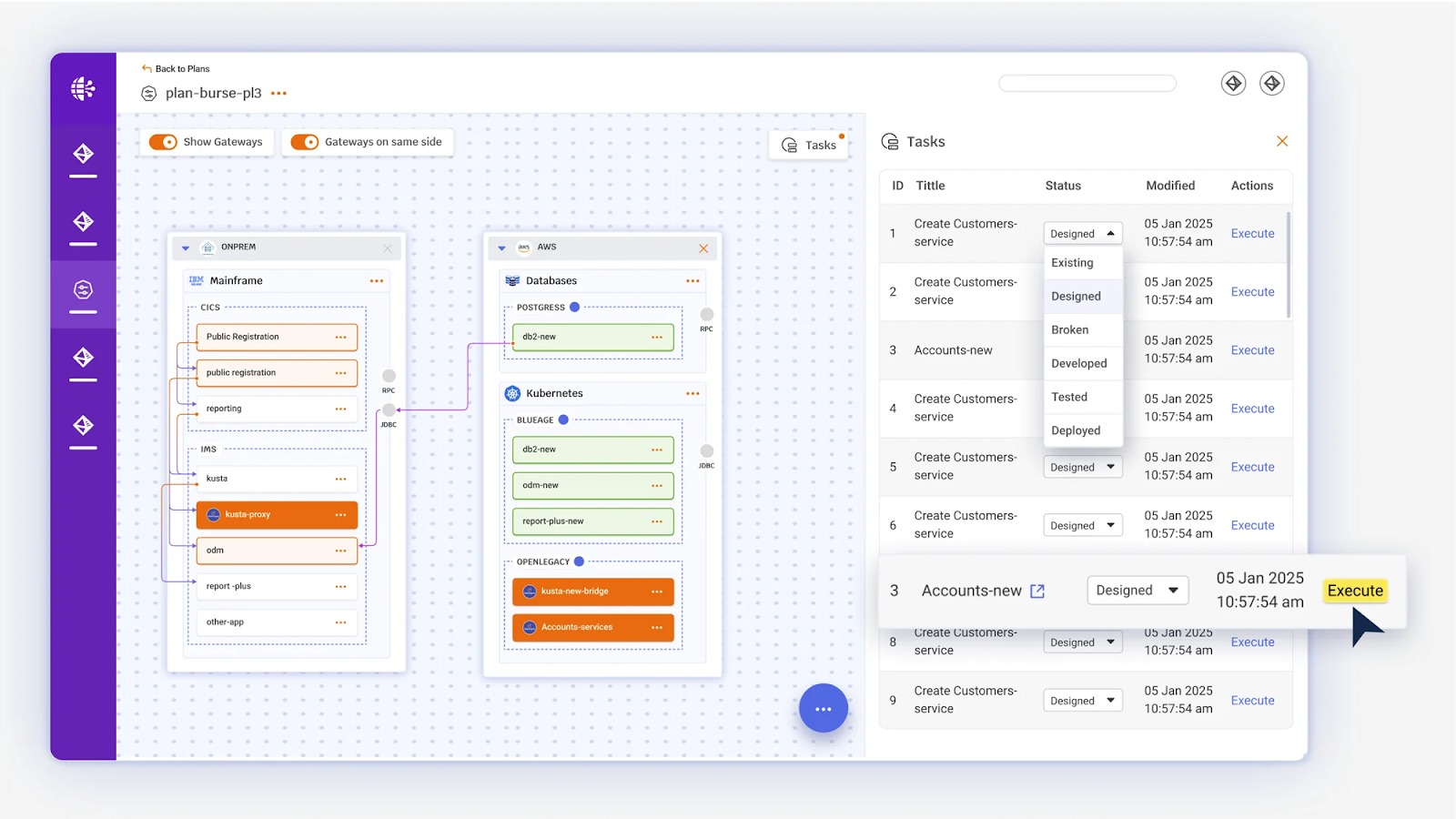
The approach is non-intrusive to the core, with no changes to core systems needed, nor the specialist skills to make them.
Minimizing modernization risk
No middleware means a flat, de-layered integration architecture that’s less susceptible to risk.
What’s more, AI is built into the platform to deeply understand your systems at the outset and mitigate risk at the planning stage of your modernization journey. The AI-powered Modernization Planner helps create your risk-free, phased roadmap to modernization success.
Accelerating time-to-market
Not only does an agile phased modernization approach mean greater simplicity and less risk, it can also speed up time-to-market.
Services that are automatically generated are ready-to-run, and all steps can be templated to optimize automation and adjust to your preferred way of working. All of which makes alignment with your DevOps pipeline quicker and simpler.
Reducing costs
Taking a hybrid cloud modernization approach with OpenLegacy’s help means you have the flexibility to choose the format, code, language, endpoints, and target deployment that fit YOUR standards.
The result is assets that are managed, documented, and stored to ensure reusability and, therefore, cost savings. The approach, too, is adaptable to any future architectural vision, meaning reduced costs in future if further changes are required.
Best practices for successful hybrid cloud modernization strategies
The key benefit of hybrid cloud modernization is that it allows you to take the agile, phased approach we’ve discussed at length. Partnering with a specialist like OpenLegacy is one way to help ensure your modernization journey is successful.
As well as that, you must take a strategic approach to the steps of your journey and build both governance and automation into the process.
Assessing applications and dependencies
The first step to any successful hybrid cloud modernization journey is to efficiently analyze where you currently stand. That means assessing your current applications, how they’re performing, and particularly, understanding the dependencies within your systems.
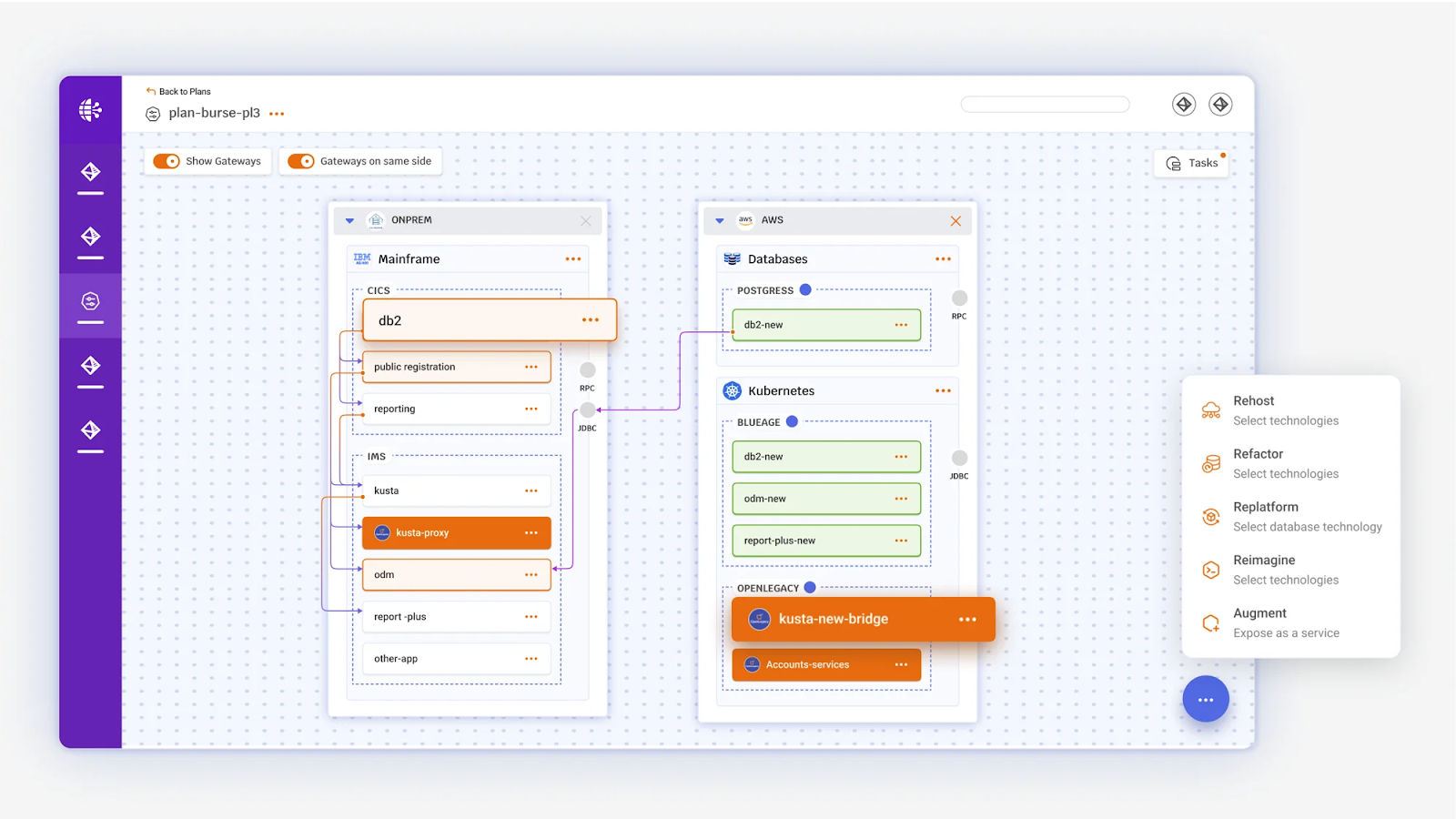
OpenLegacy’s modernization platform can visualize interdependencies and identify safe decoupling points. Thus, you can identify the pieces where you can start your modernization immediately and those to retain on-premises– at least in the short term. The AI-powered Modernization Planner then helps build a risk-free roadmap for hybrid modernization that ensures zero disruption.
Building governance into the process
Hybrid cloud governance refers to the framework of policies and controls needed to effectively manage hybrid on-premises and cloud environments.
When embarking on hybrid cloud modernization, it’s key to build this governance into the process. That means considering aspects such as resource allocation, security, and performance management at every stage.
Harness the benefits of hybrid cloud modernization with OpenLegacy
Moving on from legacy systems is the best way for enterprises to futureproof their infrastructure and ensure long-term success. “Big bang” migrations, however, are expensive and rife with risks. A hybrid cloud approach is the path to agile and phased modernization that suits your organization, and OpenLegacy is here to help.
The OpenLegacy modernization platform is powered by AI and designed to help you modernize at your pace and according to your timeframe. Phased coexistence means you can still retain your legacy systems while you need to, minimize the risk of downtime, and still ultimately transition to the cloud.
Get in touch or schedule a demo today to see how OpenLegacy can help you harness the benefits of hybrid cloud modernization.
Hybrid cloud modernization FAQs
What are the benefits of hybrid cloud architecture for legacy systems?
Adopting hybrid cloud architecture allows organizations to take advantage of both on-premises legacy systems and cloud resources, providing flexibility, scalability, and cost savings while modernizing those legacy systems.
How do APIs, decoupling patterns, and automation help in hybrid modernization?
APIs, decoupling patterns, and automation all play a key role in hybrid modernization. APIs enable seamless communication between applications, decoupling patterns help separate legacy systems to modernize each piece individually, and AI-powered automation helps streamline the process of planning and executing modernization.
What industries can benefit from hybrid cloud modernization?
Industries that have significant investments in legacy systems, such as finance, healthcare, manufacturing, and retail, can reap substantial benefits from hybrid cloud modernization. Whatever your field, though, digital transformation is a necessity, and hybrid cloud modernization is an effective avenue to that transformation.
We’d love to give you a demo.
Please leave us your details and we'll be in touch shortly