
From Core Systems to API Products
Google’s Cloud application modernization solution addresses a series of urgent challenges along your Digital Transformation
Google Cloud API Specialist
How API management supports the enterprise modernization journey
Google’s Cloud mainframe application modernization solution addresses a series of urgent challenges along your Digital Transformation:
-
How to cut costs, yet create a more agile and responsive IT system?
-
How to raise system visibility and control over applications that are more dispersed and changing than ever?
-
How to do more with legacy assets, even as companies understand better the data from a market that is changing every week?
-
How to help people work faster, with a minimum of change management?
-
How to set the stage for growth, while preserving capital?

Frequently, the answer is a step-by-step deployment of cloud computing technology, tailored to meet the most pressing needs first. Working with a comprehensive cloud provider as Google Cloud, it is possible to create cloud systems that respect and preserve core assets, while enabling rapid modernization. This is true especially for the cost-aware agility and resilience of modern application architectures. This is one of the key advantages of hybrid architectures.
However, these core services could potentially rely on legacy systems, including mainframes, mid-range systems, applications, and databases. These systems offer a trusted set of capabilities needed in the modernization process. This means that these systems will have to coexist with a modern architecture approach for a long period of time.
The challenge of unlocking legacy
Closed legacy systems are not digital-friendly. Companies know how to create legacy system APIs, but it takes months to expose the required core assets to accelerate digital experiences. This is mainly because these APIs navigate through several layers of middleware and technologies that might not be digital-friendly. In consequence, this slow-paced exposure prevents companies from delivering API driven experiences using Google Cloud Apigee.

Many enterprises are still maintaining ESB/SOA layers and multiple solutions to leverage legacy assets for their digital experiences which add time-consuming complexity and risk. Furthermore, even after the API creation, the integration performance and speed are often affected by these layers. All of these issues can lead to delays which affect budgets, staff resources, the time-to-market, and the total cost of ownership.
This is key for IT organizations running workloads on legacy systems, IT organizations require strong integration capabilities to create digital experiences via platforms and ecosystems or, SOA Architectures and proprietary stacks such as SAP, mainframes, Oracle, just to name a few.

From Legacy Systems to API Products: The Solution
The Apigee API Management Platform leverages OpenLegacy Connectors to directly integrate legacy applications in the fastest and most standardized way. This enables organizations to quickly and efficiently generate APIs for any legacy asset; by connecting directly and natively to the core application, automating code generation, and using microservices for deployment flexibility. With a couple of clicks, users can generate internal APIs with a microservices approach and accelerate the development of API Products.
Let’s put an example:
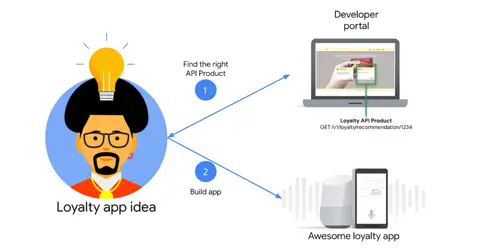
Imagine wanting to create a simple Loyalty API that recommends products to our customers. To develop the loyalty API the company leverages information coming from the CRM system. We need to understand the consumption of customer credit cards, perhaps stored in an IBM Mainframe. We also developed our own recommendation engine using GKE.
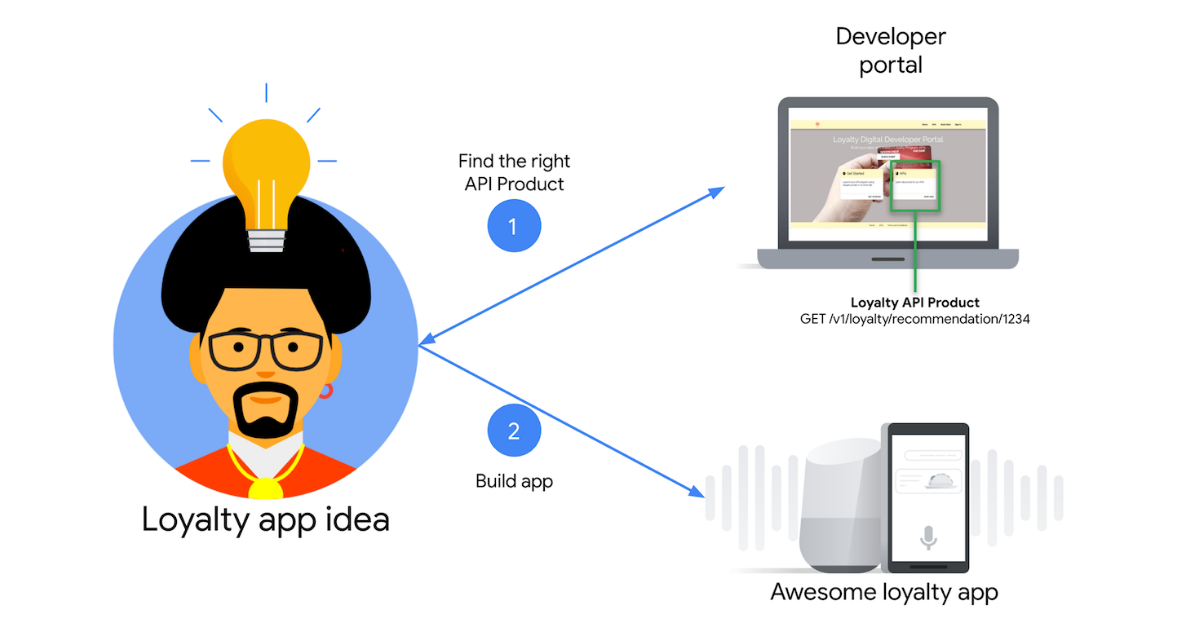
Of course, in a perfect development journey (represented in the picture below), developer’s shouldn’t be distracted by all of this complexity. They should only care about the API Product which is called “Loyalty API Product Recommendations”.
Our developer will follow these two steps in their journey:
-
Identify the API Product our developer wants to use to build the application.
-
Build an awesome experience for the final consumer.

That's simple! An API as a Product mindset should ensure that the consumption of APIs is abstracted from the production of these and, hence, reducing and hiding the complexity of the legacy backends.
So, how can we create this digital experience leveraging all of those assets and still reduce the hassle for our developers? Easy! Bridging API as products to
-
Bring the value from our Mainframe using OpenLegacy, our CRM using Apigee Extensions and consuming our custom loyalty engine from GKE via Apigee and
-
Based on the API Design first principle, focus on how you want your developers to consume this API Product and create a comprehensive developer portal to publish it.
To better understand the architecture behind the scenes, here is a diagram that represents all the flow:

Legacy unlocked, focus on business outcomes
As part of your API Strategy, Apigee becomes your digital nervous system. Now thanks to this solution, leveraging legacy and core assets of your company is possible. Some of the business results our customers see are:
Seamless & Automatic deployment.
Quick automatic generation of consumable APIs from legacy systems and managed by Apigee publishing non-complex API Products to our developer portals.
Faster Time to Market to address business needs
Delivering connected experiences leveraging core systems via APIs faster using OpenLegacy. No hand coding or custom configurations needed for usage by Apigee's Proxies.
Extremely Low Latency
Connection to the legacy system is direct, delivering optimal performance regardless of the deployment option, architecture or roadmap to the cloud.
Lower Maintenance & TCO
Improve operational efficiency by bypassing layers of complex ESB/SOA-based middleware or even leveraging the existing assets exposed by these layers with OpenLegacy.
DevOps Ready
Generate, test and deploy APIs quicker with an end-to-end (from Legacy to API Products) DevOps ready technology.
Easy Deployment into Hybrid Cloud
Microservices-based APIs for easy deployment to any cloud and/or on-prem architectures. Build your API strategy from day zero leveraging all the value from your legacy while you plan your roadmap to the cloud.
More information
If you want to know more about this solution, see it in action and/or ask any questions, don’t hesitate to contact us in the following page and emails: